

The “Feature Friction” Crisis
Feature friction refers to the gap between what enterprise software is capable of and what employees actually use. It occurs when powerful systems become difficult to operate due to complex interfaces, rigid workflows, and heavy navigation requirements.
It is late 2025, and you are reviewing the utilization reports for your enterprise software stack. You pay millions annually for Workday, ServiceNow, and SAP. These platforms are incredibly powerful, capable of handling everything from complex supply chain forecasting to intricate benefits modeling.
Yet, when you look at actual usage data, your employees are only using about 10% of these capabilities.
Why? Because accessing that other 90% requires navigating a labyrinth of menus, drop-downs, and forms.
This is the “Feature Friction” crisis. The bottleneck in your enterprise isn’t the backend capability; it is the frontend accessibility. Your employees know what they want to do (“I need to transfer a budget surplus to the marketing cost center”), but they don’t know how to do it within the rigid graphical user interface (GUI) of your ERP.
For the CIO, the solution for 2026 is not to buy simpler software. It is to deploy a Conversational agent that removes the interface entirely.
Redefining the Role: From Support to “Translation”
To understand the strategic value of a Conversational AI Assistant, we must stop thinking of it as a “support tool.”
For years, chatbots were viewed as a way to deflect helpdesk tickets. While valuable, this view is too narrow. In the emerging architecture of 2026, the Conversational AI Assistant acts as a real-time translation layer. It translates human intent (Natural Language) into system action (API syntax).
This shift changes the fundamental way work gets done. Instead of training 5,000 employees on how to navigate the new procurement portal, you simply give them a Conversational AI Assistant that knows how to navigate it for them.
The technology becomes invisible. The user speaks, and the system executes.
The “No-Training” Workforce
One of the largest hidden costs in any digital transformation is the “change management” tax the months spent training staff on new tools.
A robust enterprise ai assistant eliminates this lag time. Because the interface is conversation, the learning curve drops to zero. If an employee knows how to ask for a laptop in English, they know how to use the procurement system.This democratization of technology is the primary driver for adoption in 2026. It turns every employee into a “power user” of your most complex systems without them ever needing to watch a training video.
Architecture of a Modern Conversational AI Assistant
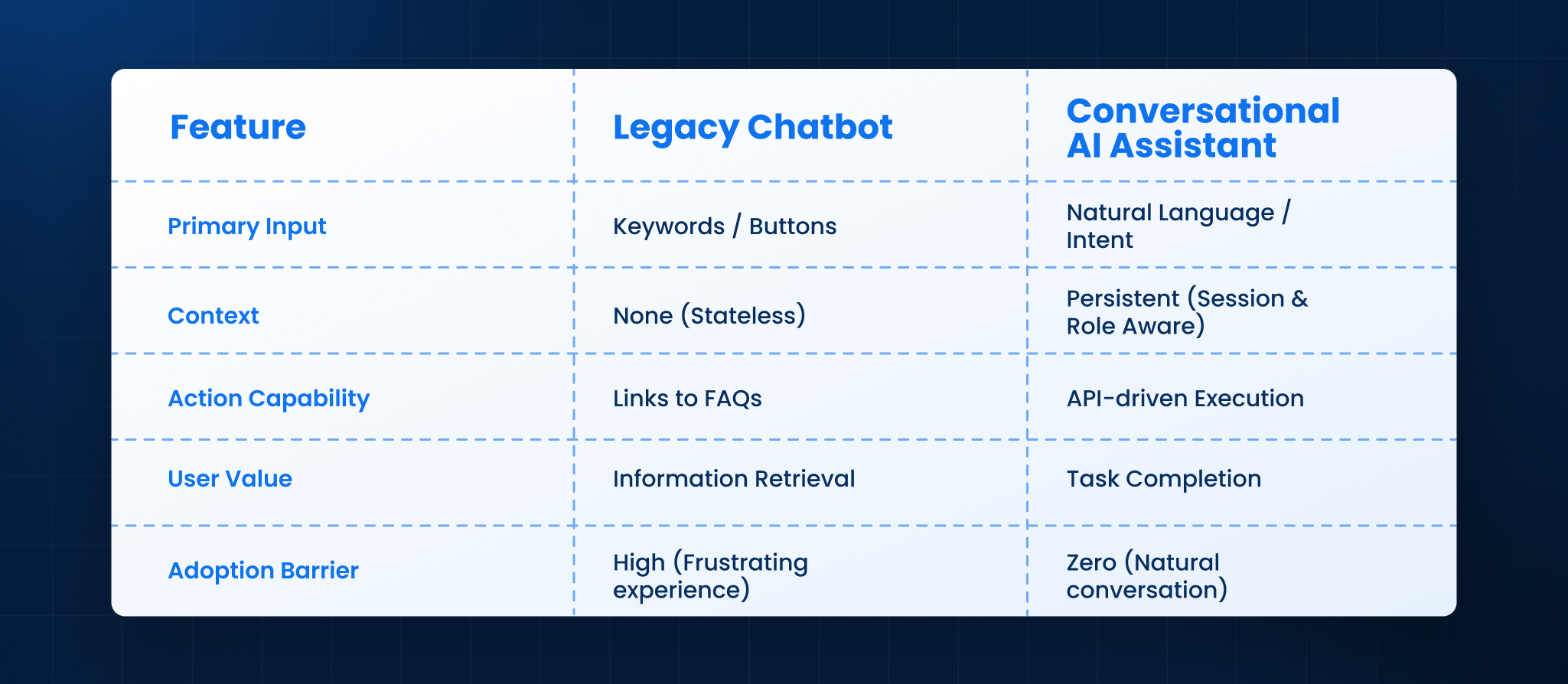
What differentiates a legacy chatbot from a modern intelligent virtual assistant? It comes down to “State Management” and “Context.”
Legacy bots were amnesiacs. They treated every question as a standalone event. If you asked, “What is my vacation balance?” it answered. If you then said, “Okay, book next Friday off,” it had no idea who “you” were or what “next Friday” meant in relation to the balance it just checked.A true Conversational AI Assistant maintains a “state.” It remembers the context of the session and the user’s role. It understands that “book it” is a command related to the previous query.
Leena AI: The “Language-First” Enterprise Layer
At Leena AI, we are building the interface for the post-GUI world. We believe that the most efficient way to operate enterprise software is not to click through it, but to talk to it.
Our Conversational AI Assistant platform is designed to sit as a unified layer across your entire technology stack. We act as the “universal translator” for your back office.
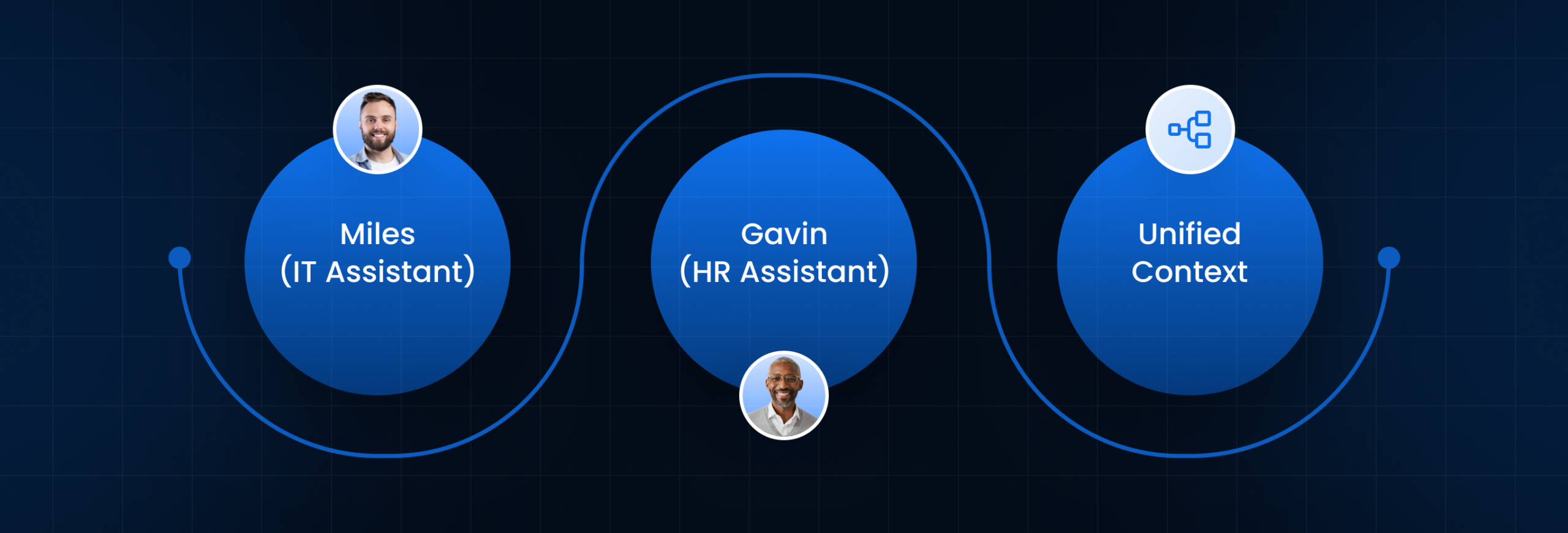
- Miles (IT Assistant): An employee doesn’t need to know the difference between a “Service Request” and an “Incident” in ServiceNow. They just tell Miles, “My Wifi is broken.” Miles translates that intent, categorizes the ticket, and even runs a script to reset the network adapter on the device.
- Gavin (HR Assistant): Instead of navigating four different tabs in the HCM to find “Dependent Benefits,” an employee simply asks Gavin to “Add my newborn to my insurance.” Gavin handles the backend complexity, ensuring the data lands correctly in the database.
- Unified Context: Leena AI’s assistants share memory. If an employee is asking about maternity leave (HR), the assistant can intelligently suggest checking the laptop return policy (IT) for long-term leave, creating a seamless, anticipatory experience.
By abstracting the complexity of the underlying systems, Leena AI ensures that your backend systems remain robust and secure, while your frontend experience remains simple and human.
This shift toward conversational interfaces is not theoretical. It is already reshaping how enterprises allow employees tointeract with IT, HR, and finance systems without needing to understand the underlying tools
Governance in a Conversational World
For the technology head, the move to a conversational ai platform raises questions about precision. A GUI is rigid you can only click what is allowed. Conversation is messy people can say anything.
This is why “Intent Recognition” and “Slot Filling” are the governance pillars of 2026.
A secure ai chatbot for enterprise does not just guess. It identifies the specific “slots” required for a transaction (e.g., Date, Amount, Cost Center). If the user’s conversational input misses a slot, the assistant pauses and asks for it.
Furthermore, leading platforms integrate with your existing Identity and Access Management (IAM) providers (like Okta or Azure AD). The virtual assistant ai knows exactly who is talking to it. It will not allow a Junior Analyst to execute a “Manager Approval” command, no matter how nicely they ask. The conversation is fluid, but the permissions are rigid.
The End of the “Toggle Tax”
The ultimate ROI of the Conversational AI Assistant is the elimination of the “Toggle Tax” the time lost switching between 15 different apps to do a day’s work.
In 2026, the most productive employees won’t be the ones who are fastest at clicking through tabs. They will be the ones who can orchestrate their work through a single, intelligent conversation.For the CIO, this is the final mile of digital transformation. You have modernized your infrastructure; now it is time to modernize the access.
As conversational AI becomes the primary access layer for enterprise systems, organizations are beginning to evaluate it not as a chatbot, but as core digital infrastructure that drives adoption, governance, and operational efficiency.
Frequently Asked Questions
How is a Conversational AI Assistant different from a standard search bar?
A search bar retrieves documents (passive). A Conversational AI Assistant executes tasks (active). While search can find the “How to” guide for a password reset, the assistant can actually connect to the directory and reset the password for you during the chat.
Can a Conversational AI Assistant handle complex, multi-step workflows?
Yes. This is the definition of “Agentic” capability. If a request involves multiple steps like “Onboard a new vendor” (which requires NDA signature, Finance approval, and IT system access) the assistant can orchestrate this entire chain, pausing to ask the user for input only when necessary.
Does implementing a conversational ai platform require replacing our current apps?
No. The assistant acts as an “overlay” or “middleware.” It connects to your existing apps (Workday, Salesforce, Jira) via APIs. You keep your Systems of Record exactly as they are; the assistant just changes how humans interact with them.
How does the assistant handle vague or unclear user requests?
A modern intelligent virtual assistant uses “disambiguation.” If a user says “Check status,” the assistant will look at the user’s recent history and ask, “Do you mean the status of your IT ticket #123 or your Expense Report #456?” It clarifies intent before acting.
Is the Conversational AI Assistant secure for sensitive HR data?
Yes. Enterprise-grade assistants like Leena AI are built with “Privacy by Design.” They do not train public models on your data. They adhere to strict SOC2 and GDPR standards, and they respect the Role-Based Access Control (RBAC) of the underlying systems they connect to.
What is the typical adoption timeline for a Conversational AI Assistant?
Because there is no user training required, adoption is often rapid. Once deployed on a familiar channel like Microsoft Teams or Slack, employees typically begin using the Conversational AI Assistant immediately for low-stakes tasks (FAQs), graduating to complex transactional tasks (workflows) as trust is established.