

HRM AI in 2026: Governance Risks in Sentiment-Based Prediction
It is Q3 of 2026. Your North American Sales Division just missed its target for the second consecutive quarter. More concerning, three of your top five regional directors resigned in the same week. The exit interviews were polite but vague standard references to “new opportunities.”
To your leadership team, this retention crisis feels like a sudden earthquake. But deep in your back-office systems, the tremors were visible months ago.
Since February, the support tickets from that sales division had changed. The volume was steady, but the tone had shifted. Requests for travel reimbursements became terse. IT tickets for laptop refresh cycles were filed with unusual urgency and frustration. The “Thank You” messages to the helpdesk bots dropped by 40%.
Your HRM AI system logged all of this. It saw the sentiment plunge. It flagged the anomaly in a database row that no one looked at.
This is the paradox of the modern enterprise. We have successfully deployed HR AI Agent to automate the “doing” the password resets and the policy lookups. But we are failing to govern the “sensing.” We are sitting on a goldmine of behavioral exhaust data that could predict organizational risk, but we lack the protocols to use it safely.
As technology leaders, we need to talk about the governance of HRM AI as a listening engine. Using AI to predict attrition is not a technical problem anymore; it is an ethical and operational minefield.
The Shift from Transaction to Signal in HRM AI
In the early days (circa 2023-2024), the value proposition of HRM AI was purely transactional. We measured success by deflection rates and cost savings. If the bot answered the question, we won.
In 2026, the value has moved up the stack. Every interaction an employee has with an HRM AI system is a data point in a massive, continuous longitudinal study of your workforce’s mental health.
Unlike a quarterly engagement survey, which is performative (employees tell you what they think you want to hear), HRM AI interactions are organic. When an employee argues with a chatbot about a denied expense at 11:00 PM on a Friday, that is a raw, unfiltered signal of burnout.
However, capturing this signal introduces a new failure mode for the CIO: The “Big Brother” Liability.
If your HRM AI predicts that a specific high-performer is a “flight risk” based on their ticket syntax, what do you do? If you intervene, you reveal that you are analyzing their private interactions. If you do nothing and they leave, you failed to protect the business. This is the tightrope of HRM AI governance.
The Shift from Transaction to Signal in HRM AI
The first risk is technical validity. Not all Hrm ai tools are calibrated for the nuances of your specific corporate culture.
In a large US enterprise, communication styles vary wildly. A terse, direct ticket from a New York trading desk might read as “hostile” to a generic model, while being completely normal for that team. Conversely, a passive-aggressive polite request from a Southern regional office might mask deep frustration.
If your HRM AI sentiment models are generic, they will generate false positives. You risk flagging healthy, high-intensity teams as “toxic,” leading to unnecessary HR interventions that erode trust. We must demand that our Hrm ai tools allow for “cultural baselining” learning what normal looks like for different departments before flagging deviations.
Governance and Privacy: The “Creepy” Factor
The most significant barrier to operationalizing sentiment analysis in HRM AI is employee trust. If the workforce believes that the Hrm ai chat interface is a surveillance device reporting their mood to their manager, adoption will collapse.
We have seen this happen. A major logistics firm turned on “individual sentiment scoring” visible to line managers. Within a month, ticket volume dropped by 30% as employees stopped using the automated system, fearing that a frustrated comment about a broken printer would impact their performance review. They went back to calling the helpdesk, killing the ROI of the automation.
Governing the HRM AI Agent
To mitigate this, technology leaders must enforce a strict “Aggregation Firewall.”
The Hrm ai agent should never report sentiment data at the individual level to operations management. The data must be aggregated to the cohort level (e.g., “Northeast Sales Team” or “L2 Engineering”).
- Bad Governance: “John Smith in Accounting is 80% likely to resign.”
- Good Governance: “The Accounting Department is showing a 40% spike in frustration markers related to the new expense policy.”
This approach protects individual privacy while preserving the strategic value of the HRM AI signal. It allows leadership to fix the systemic issue (the expense policy) rather than targeting the symptom (John Smith).
Operationalizing the Signal: From Data to Action
Assuming you have solved the privacy and calibration issues, the next challenge is operational. How do you wire this “Risk Radar” into your decision-making without creating noise?
Most organizations suffer from “Dashboard Fatigue.” Adding a “Sentiment Heatmap” to the CIO’s Monday morning report does not guarantee action.
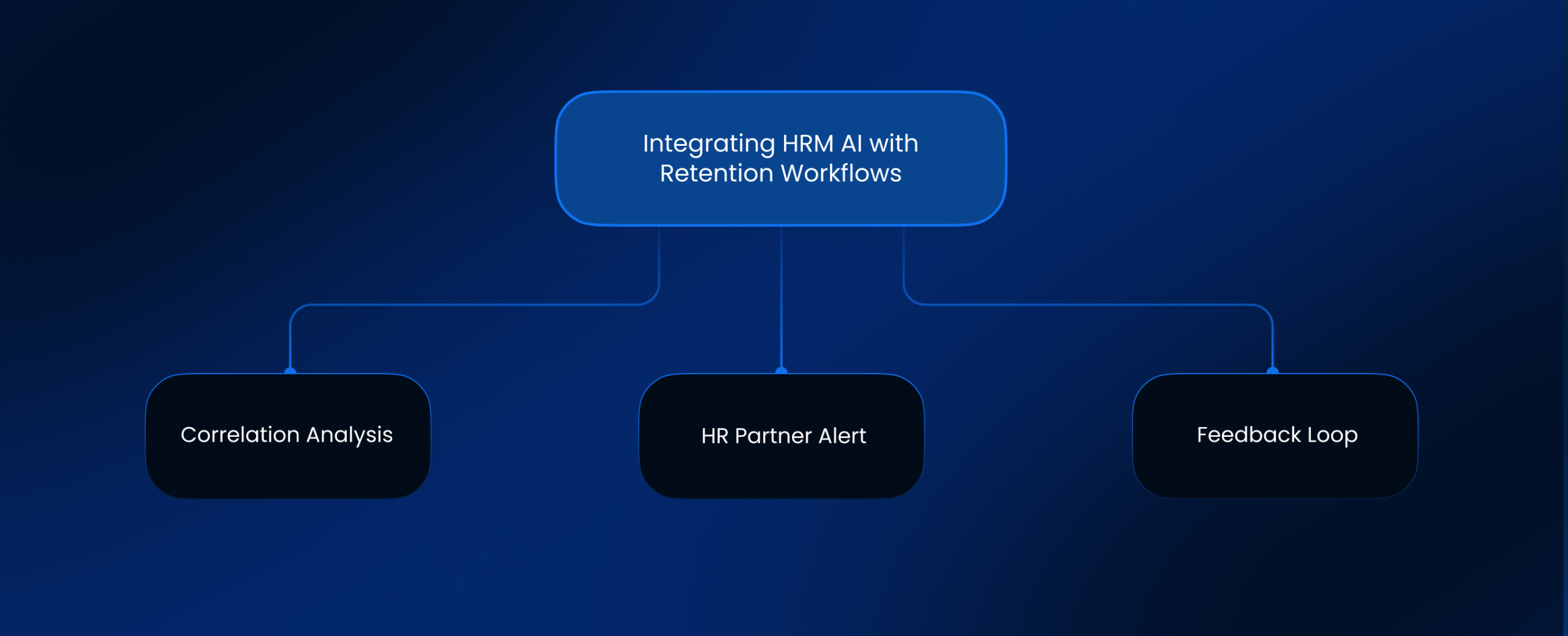
Integrating HRM AI with Retention Workflows
The insight from HRM AI needs to trigger a workflow, not just a chart.
If the HRM AI detects a sustained drop in sentiment in the Engineering division, it should automatically trigger a “Deep Dive” protocol:
- Correlation Analysis: The system cross-references the sentiment drop with recent IT changes (e.g., did we just roll out a buggy VPN patch?) or HR changes (did we announce a return-to-office mandate?).
- HR Partner Alert: The HR Business Partner for Engineering receives a notification not about specific people, but about the trend.
- Feedback Loop: The system prompts the Hrm ai chat interface to ask a random sample of that cohort a contextual feedback question during their next interaction (e.g., “How was your experience with the new VPN?”).
This turns HRM AI from a passive observer into an active diagnostic tool. It closes the loop between “sensing” a problem and “identifying” the root cause
The Bias in the Machine
We must also address the risk of algorithmic bias in HRM AI sentiment detection.
Language models, even in 2026, can carry historical biases. They might rate the vernacular of certain demographic groups as less “professional” or more “aggressive” than others. If your retention risk scores are derived from these biased readings, your HRM AI system could inadvertently steer HR resources away from minority groups or unfairly flag them as problem areas.
As the technology head, you must mandate “Algorithmic Audits.” You need to run tests to ensure that the Hrm ai agent scores identical sentiment consistently across different linguistic styles. If you skip this step, you are not just risking bad data; you are risking a discrimination lawsuit.
Leena AI: Designing for Safety and Trust
At Leena AI, we recognize that the power of HRM AI is useless without the trust of the workforce. That is why we architect our platforms with a “Privacy First” philosophy.
We deliberately design our analytics engine to prioritize systemic health over individual surveillance. Our Risk Radar aggregates sentiment signals into anonymized cohorts, giving leadership the visibility they need to prevent burnout without crossing the line into “spying.”
Furthermore, our proprietary WorkLM model is trained on diverse enterprise datasets to understand the nuance of workplace communication. It distinguishes between an employee who is frustrated with a software bug (an IT problem) and an employee who is frustrated with the company (an HR problem). This contextual awareness reduces false positives and ensures that your HR AI Agent insights drive meaningful, positive change for your organization.
Conclusion: The Responsibility of Listening
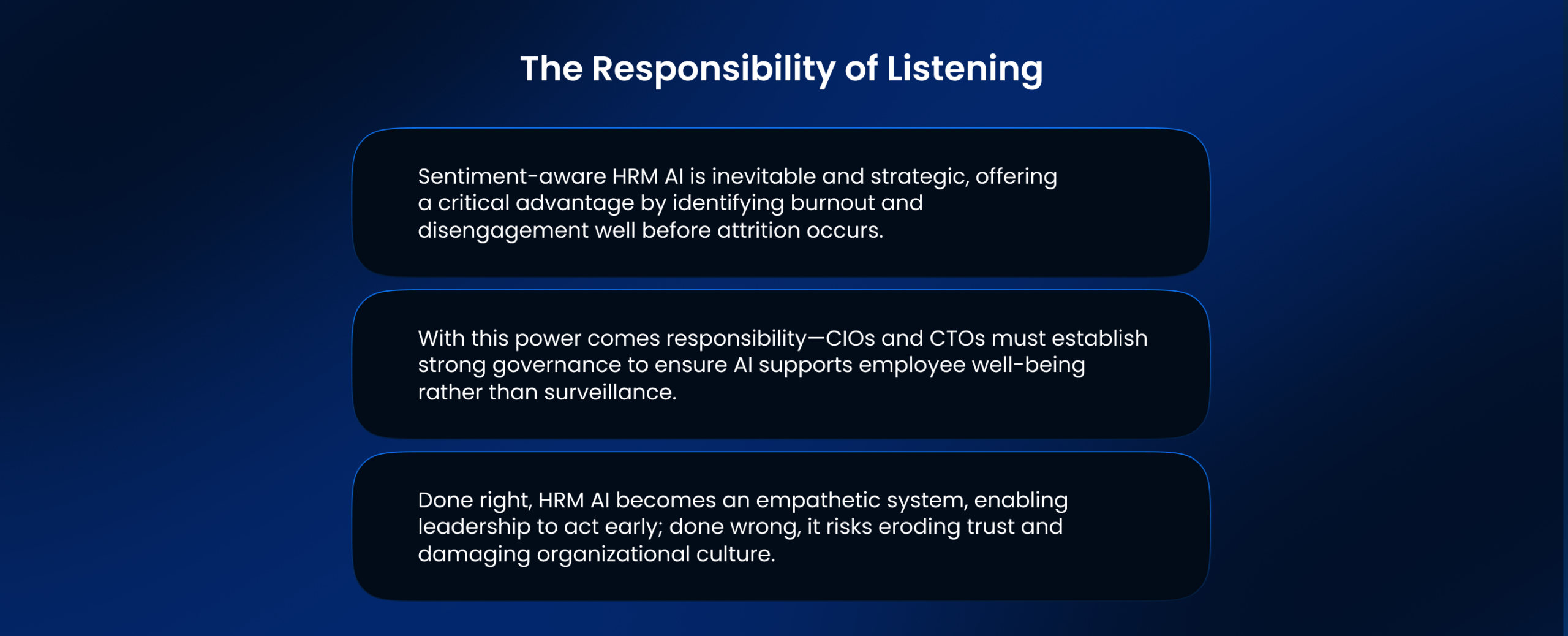
The transition to sentiment-aware HRM AI is inevitable. The data is too valuable to ignore. In a competitive talent market, knowing that a department is burning out three months before they quit is a massive competitive advantage.
But this power comes with a heavy governance burden. As CIOs and CTOs, we are the custodians of this new nervous system. We must build the guardrails that ensure HR AI Agent is used to heal the organization, not to police it.
If we get this right, HR AI Agent becomes the most empathetic tool in our stack a system that listens to the whispers of the workforce so leadership can act before they turn into screams. If we get it wrong, we destroy the very culture we are trying to save.
Frequently Asked Questions
Is it legal to analyze employee sentiment using HRM AI?
In the US, generally yes, provided the data is collected from company-owned channels (tickets, work chats) and disclosed in your acceptable use policy. However, using HRM AI to analyze sentiment for the purpose of union-busting or protected activity monitoring is illegal. Always consult legal counsel and focus on aggregated data to mitigate risk.
How accurate is HRM AI at predicting attrition?
It varies by implementation, but HRM AI is typically a strong directional indicator. It is better at predicting “risk pools” (e.g., “This team is at risk”) than specific individual resignations. It should be used as a “smoke detector,” not a crystal ball.
Does implementing this require a new tech stack?
Not necessarily. Modern HRM AI platforms often sit as an overlay on top of your existing systems (ServiceNow, Workday, Slack/Teams). They ingest the logs from these systems via API to perform the analysis, meaning you don’t need to rip and replace your core infrastructure.
What is the difference between Hrm ai tools and standard engagement surveys?
Surveys are episodic (quarterly/yearly) and conscious (employees choose what to say). Hrm ai tools analyze continuous, unconscious data (the “exhaust” of daily work). The latter is often a more honest reflection of real-time friction in the workplace.
How do we handle false positives from the Hrm ai agent?
You need human validation. If the Hrm ai agent flags a department as “high risk,” do not immediately launch an intervention. Use the data to hypothesize, then verify with qualitative conversations or targeted micro-surveys. Never automate the “fix” based solely on the sentiment score.
Can HRM AI detect burnout specifically?
Yes. HRM AI looks for patterns like “after-hours activity,” “increased error rates in requests,” and “negative sentiment syntax” (e.g., words like exhausted, impossible, urgent). When these cluster together, it is a high-confidence signal of burnout.
Who should own the insights from HRM AI?
This should be a shared ownership model between the CIO (who owns the data/tool) and the CHRO (who owns the action). The CIO ensures the HRM AI is working and governed correctly; the CHRO decides how to act on the retention signals it generates.