
What are AI Agents for Enterprises?
AI Agents for Enterprises are advanced software systems designed to perform autonomous tasks within a business environment. Unlike passive AI tools that wait for a prompt, AI Agents are goal-oriented: they perceive their environment, reason through complex problems, and use enterprise tools (like CRM, ERP, or HRIS) to execute workflows from start to finish.
These agents act as a digital workforce, capable of handling multi-step processes such as “Resolve this customer dispute” or “Reconcile these invoices” without requiring constant human supervision.
Simple Definition:
- Standard AI (Chatbot): Like a librarian. You ask a question, and it gives you information from a book.
- AI Agent: Like a research assistant. You give it a project, and it goes out, reads the books, writes the summary, emails the experts, and files the report for you.
2. Key Features
To be enterprise-ready, an AI Agent must possess five specific capabilities that separate it from consumer AI:
- Goal Decomposition: The ability to take a vague command (e.g., “Plan a marketing launch”) and break it down into 50 specific, actionable steps.
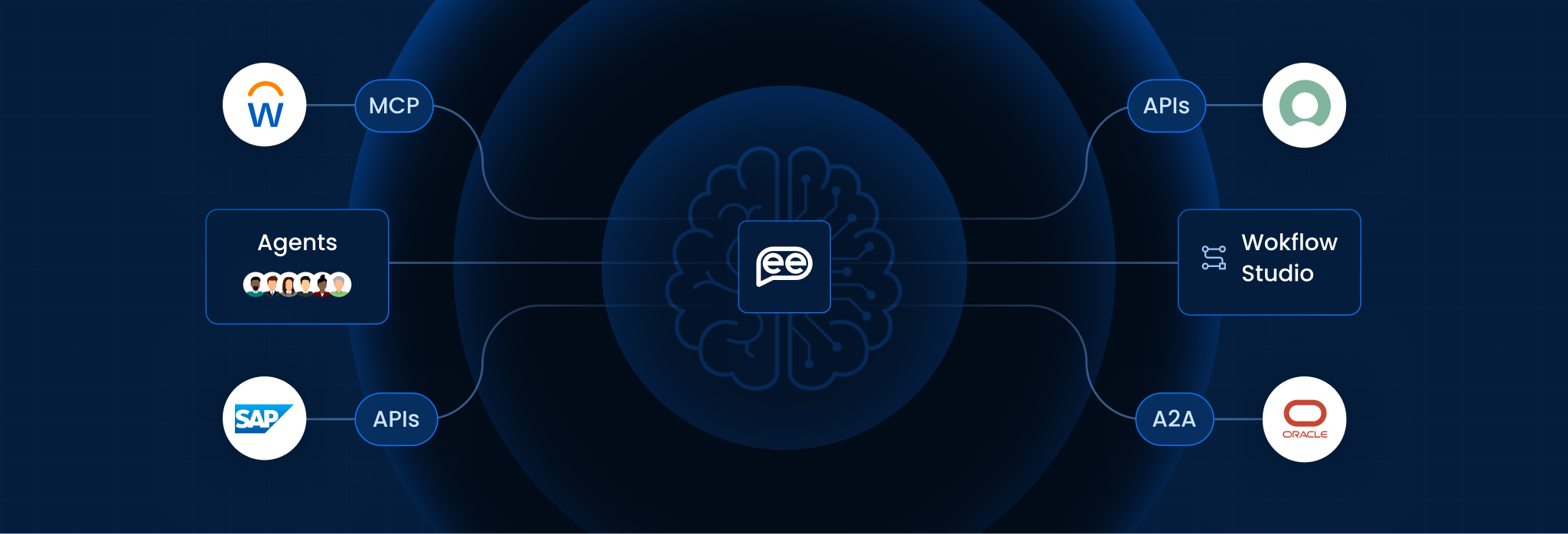
- Tool Usage (Function Calling): The agent can securely “handshake” with other software to read data, update records, or trigger alerts via APIs.
- Long-Term Memory: It remembers context from weeks ago (e.g., “This is the same client who had an issue last month”), ensuring continuity in relationships.
- Guardrails & Governance: It operates within strict safety boundaries, ensuring it never promises a refund or shares data outside of company policy.
- Multi-Agent Collaboration: Specialized agents (e.g., a “Coder Agent” and a “Tester Agent”) can talk to each other to solve problems faster than one agent working alone.
3. AI Agents vs. Standard Chatbots (Capability Matrix)
This table highlights the shift from “Conversation” to “Action.”
| Capability | Standard Chatbot (Generative AI) | Enterprise AI Agent (Agentic AI) |
| Primary Function | Inform: Answers questions using training data. | Execute: Performs tasks using external tools. |
| Memory Span | Short: Forgets context after the chat window closes. | Long: Remembers user history and preferences forever. |
| Autonomy Level | Passive: Waits for the user to prompt it. | Proactive: Can trigger itself based on alerts or schedules. |
| Complexity | Single-Turn: Good for “What is X?” queries. | Multi-Step: Good for “Fix X, then email Y” workflows. |
4. How It Works (The Agent Architecture)
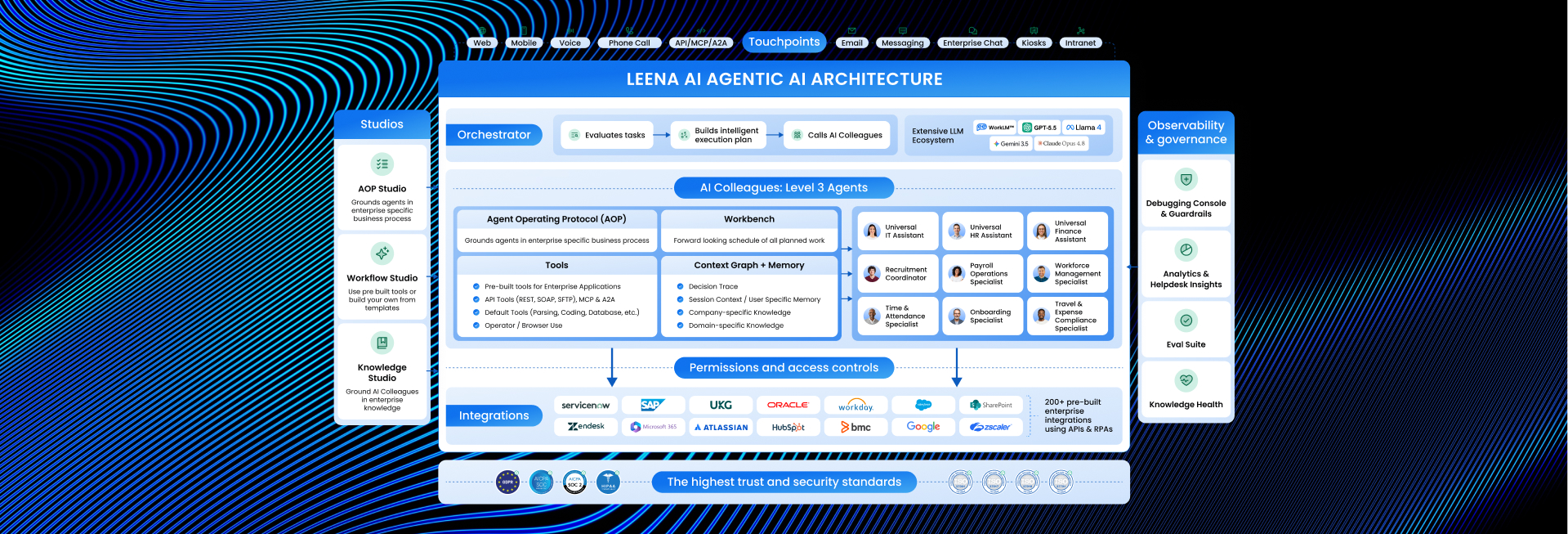
Enterprise AI Agents operate using a sophisticated “Cognitive Architecture” often described as Brain + Hands:
- The Brain (LLM): The core model (like GPT-4 or Claude) understands the user’s intent and reasoning.
- The Memory (Context): The agent retrieves relevant company policies and past interactions from a Vector Database.
- The Planner (Reasoning): It formulates a step-by-step plan to achieve the goal, checking for potential errors.
- The Tools (Action): It uses APIs to interact with the real world sending emails, querying databases, or creating tickets.
- The Critic (Reflection): Before finalizing, it reviews its own work. If the output looks wrong, it self-corrects.
5. Benefits for Enterprise
Adopting AI Agents is a strategic move that goes beyond simple cost-cutting. According to Gartner and Forrester trends for 2026:
- Scale Without Headcount: Companies can handle 10x the volume of support tickets or data entry tasks without hiring more staff.
- 24/7 Operational Uptime: Critical processes (like server monitoring or fraud detection) run continuously, not just during business hours.
- Knowledge Preservation: When a human expert leaves, their knowledge is often lost. An AI Agent retains that process knowledge permanently within the system.
Frequently Asked Questions
Are AI Agents safe?
Yes, but they require “Constitutional AI” frameworks. This means the agent is given a strict set of rules (a constitution) it cannot break such as “Never share PII” or “Never approve payments over $1,000 without human sign-off.”
How do they differ from RPA (Robotic Process Automation)?
RPA is for structured tasks (e.g., “Copy cell A to cell B”). AI Agents are for unstructured tasks (e.g., “Read this messy email and decide if it’s a complaint or a compliment”). Agents are flexible; RPA is rigid.
Do they hallucinate?
They can, but enterprise agents use RAG (Retrieval-Augmented Generation) to minimize this. They are forced to cite sources from internal company documents before answering, ensuring accuracy.
Can agents talk to each other?
Yes. In a “Multi-Agent System,” a Sales Agent might qualify a lead and then hand it off to a Scheduling Agent to book the meeting, coordinating seamlessly in the background.
How long does it take to train an agent?
It varies. A simple FAQ agent can be ready in days. A complex operational agent that integrates with 5+ systems typically takes 4-8 weeks to configure and test for safety.
Will agents replace employees?
They replace tasks, not necessarily roles. They act as “force multipliers,” allowing one human employee to manage the output of 10 digital agents, effectively becoming a manager of AI.
Want To Know More?
Book a Demo