

The “Successful” Ticket That Failed the Employee
It is a common paradox in the modern enterprise. Your Information Technology team reports a ninety-nine percent success rate on ticket closures. Your Human Resources dashboard shows that onboarding requests are processed within twenty-four hours. Your Finance tools are flagging invoices faster than ever.
Yet, your employees are frustrated.
Why? Because enterprise work rarely lives in a single silo. A “successful” password reset ticket in the Information Technology portal is meaningless if the employee still cannot access the payroll application because the Human Resources system has not updated their role.
We are entering late 2025 with a “Tool Sprawl” crisis. Enterprises have purchased excellent point solutions for every department, but they lack a connective tissue. The result is a fragmented experience where the employee has to act as the “human middleware,” manually carrying data from one successful tool to another.
The strategic imperative for the coming year is not to buy another tool. It is to consolidate these disparate capabilities into a cohesive ai automation platform. This is the shift from optimizing tasks to orchestrating outcomes.
Why the Enterprise Needs a Unified AI Automation Platform
For the last decade, the strategy was “best-of-breed.” You bought the best ticketing system, the best Human Capital Management system, and the best Enterprise Resource Planning system.
However, in an era defined by ai automation, this approach creates friction. When intelligence is trapped inside a specific tool, it cannot solve multi-disciplinary problems. An artificial intelligence bot in your expense software cannot see that the employee is on leave in your Human Resources software.
A true ai automation platform solves this by sitting above the individual applications. It acts as an intelligent orchestration layer. It does not replace your system of record; it unlocks it.
For the Chief Information Officer, adopting an ai automation platform is about regaining control over the digital employee experience. It allows you to define workflows that cut across departmental boundaries Information Technology, Human Resources, and Finance managed from a single “brain” rather than a dozen disconnected scripts.
Moving Beyond Disconnected Tools and Automation
To understand the value of this platform approach, we must look at the limitation of legacy tools and automation.
Traditional automation scripts are fragile. They are designed to do one thing repeatedly. If the process changes, the script breaks. If the data format shifts, the bot fails.
An ai automation platform, by contrast, is resilient. It uses a semantic understanding of the enterprise to navigate changes. If an Application Programming Interface endpoint updates, the platform can often adapt or flag the issue intelligently without crashing the entire workflow.
This resilience is critical because, in 2026, the speed of business will not tolerate brittle automation. Systems must be able to heal themselves and adapt to new business rules instantly.
The Role of Agentic AI in an AI Automation Platform
The engine that powers this new class of platform is agentic ai.
Standard automation is passive; it waits for a command. Agentic ai is active; it understands a goal. When you embed agentic ai into your ai automation platform, you are not just programming a sequence of steps; you are defining an objective.
For example, instead of building a script that says, “If form A is submitted, send email B,” you tell the platform, “Ensure the new hire has all necessary software provisioning by day one.”
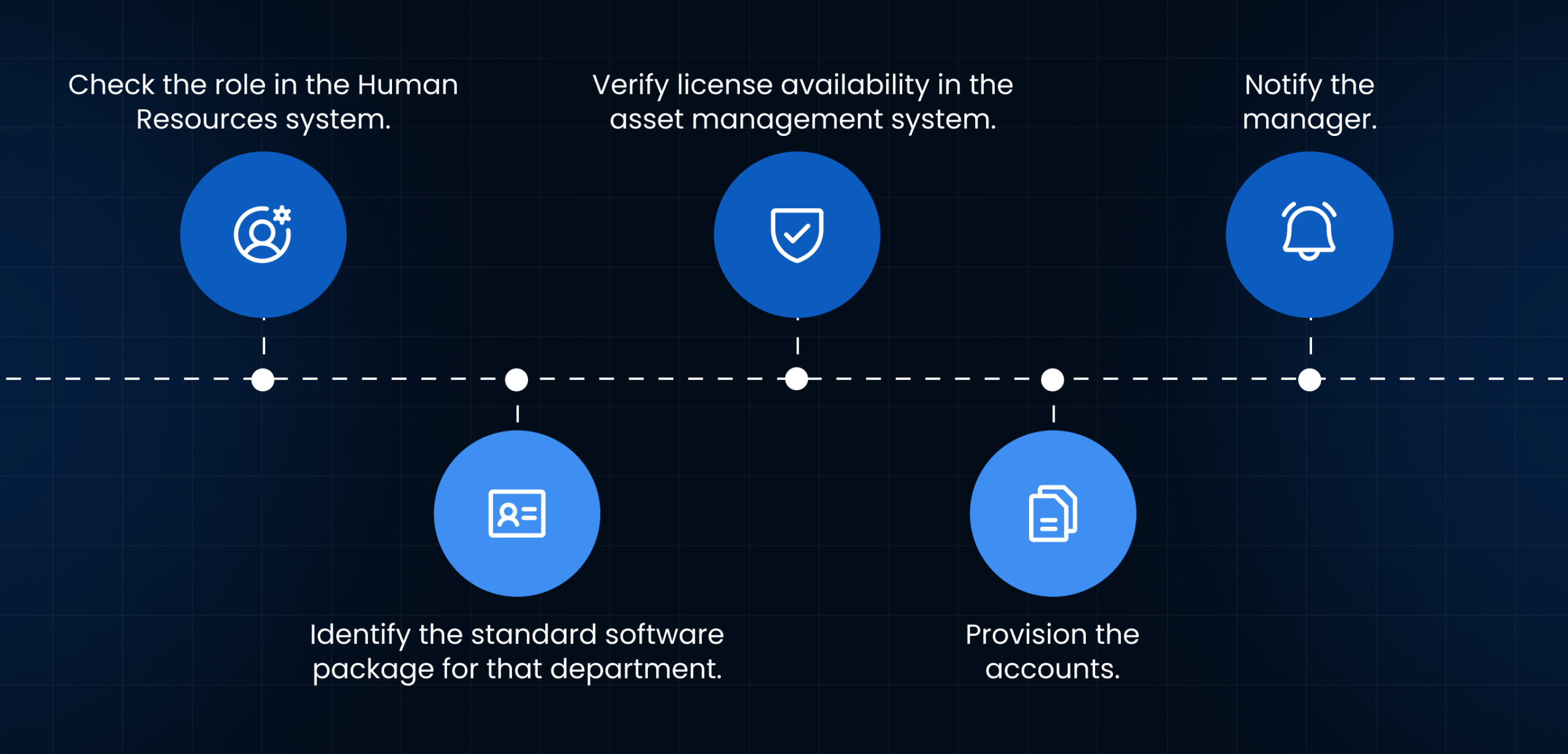
The agentic ai capabilities within the platform then determine the necessary steps:
- Check the role in the Human Resources system.
- Identify the standard software package for that department.
- Verify license availability in the asset management system.
- Provision the accounts.
- Notify the manager.
If the license is unavailable, the agent does not just fail; it triggers a procurement request workflow. This level of autonomous decision-making is what separates a modern ai automation platform from a legacy workflow tool.
Evaluating an AI Automation Platform vs. Point Solutions
For technology leaders, the challenge is often distinguishing between a true platform and a collection of features.
A point solution might offer “AI features,” but it is limited to its own data. An ai automation platform is data-agnostic and system-agnostic. It treats your entire enterprise architecture from legacy on-premise databases to modern cloud applications as a single playground for execution.
The Convergence of Tools and Automation
The market is seeing a rapid convergence of tools and automation. Vendors that previously sold niche chatbots are scrambling to build platform capabilities. However, a true ai automation platform is built from the ground up for integration, not just conversation.
When evaluating these systems, look for the ability to handle “long-running transactions.” Can the platform manage a request that takes three days to complete, requires approval from two different humans, and touches four different systems? That is the litmus test for enterprise-grade ai automation.
Governance and Control in the Platform Era
One of the primary fears regarding agentic ai and autonomous platforms is the loss of control. If the system is making decisions, how do we ensure it complies with company policy?
Paradoxically, an ai automation platform offers better governance than the status quo.
Currently, business logic is scattered. Some rules are in a spreadsheet in Finance, others are hard-coded into an Information Technology script, and some exist only in the heads of your Human Resources business partners.
By centralizing these workflows into an ai automation platform, you create a single source of truth for policy execution.
- Auditability: Every decision made by the AI why it approved an expense, why it granted access is logged centrally.
- Standardization: You ensure that the “Travel Expense Policy” is applied exactly the same way, whether the request comes from the New York office or the London office.
- Observability: Technology leaders gain a “Control Tower” view of operations, allowing them to see bottlenecks across the entire organization, not just within one department.
Leena AI: The Unified AI Automation Platform for AI Colleagues
At Leena AI, we have engineered our solution to be the operating system for the modern back office. We do not just sell a chatbot; we provide a comprehensive ai automation platform that powers our AI Colleagues.
Our approach is designed to eliminate the fragmentation that plagues large enterprises.
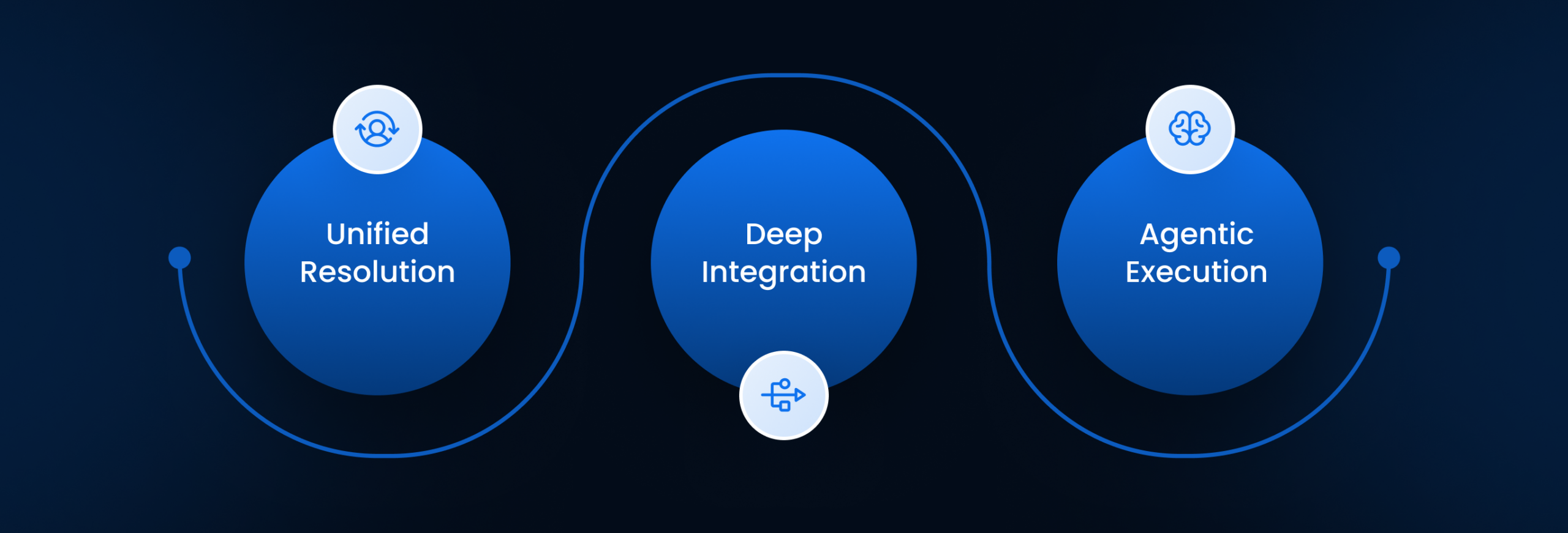
- Unified Resolution: Our AI Colleagues sit on top of the ai automation platform to serve as the single interface for employees. Whether they need to reset a password (Information Technology), update a tax form (Finance), or check leave balance (Human Resources), the platform routes the request to the right backend system instantly.
- Deep Integration: We go beyond surface-level Application Programming Interfaces. Our platform is capable of reading and writing to complex enterprise systems like Workday, ServiceNow, SAP, and Oracle, ensuring that the AI Colleague can actually do the work, not just talk about it.
- Agentic Execution: Leena AI’s platform utilizes agentic ai to reason through complex workflows. If an employee asks a question that requires data from three different sources, our platform orchestrates those queries autonomously and synthesizes the answer, removing the burden from the user.
By deploying Leena AI, enterprises are not just automating tasks; they are installing a layer of intelligence that makes their existing systems smarter, faster, and more accessible.
The 2026 Standard: The Platform is the Strategy
As we look toward 2026, the era of “shadow automation” where every department buys its own bot is ending. The cost in complexity and technical debt is simply too high.
The future belongs to the ai automation platform. It is the only architectural approach that can scale with the demands of the modern workforce. It turns the back office from a cost center of disconnected tasks into a strategic engine of streamlined execution.
For the Chief Information Officer and Chief Technology Officer, the mandate is clear: Stop buying tools that create silos. Start building a platform that creates flow.
Frequently Asked Questions
What is the difference between an ai automation platform and Robotic Process Automation?
Robotic Process Automation is designed for repetitive, rule-based tasks (like copying and pasting data). An ai automation platform uses intelligence to handle ambiguity, reason through complex problems, and integrate across multiple systems via Application Programming Interfaces, not just screen scraping. It is the difference between a macro and a digital worker.
How does an ai automation platform improve data security?
Centralizing automation on a single platform allows for a unified security posture. Instead of managing access credentials across fifty different scripts and tools, you manage them within the secure environment of the ai automation platform. It also provides a centralized audit log for all autonomous actions, significantly improving compliance visibility.
Can we use an ai automation platform if we have legacy on-premise systems?
Yes. A robust enterprise ai automation platform acts as a bridge. It can connect to modern cloud applications via Application Programming Interfaces while simultaneously interacting with legacy on-premise databases, effectively “modernizing” your legacy tech stack without requiring a full rip-and-replace migration.
What role does agentic ai play in reducing IT ticket volume?
Agentic ai allows the platform to resolve tickets end-to-end without human intervention. Instead of just triaging a ticket to a human agent, the system understands the intent (e.g., “unlock account”), verifies the user’s identity, and executes the fix in the directory service autonomously, removing the ticket from the queue entirely.
How long does it take to implement an enterprise ai automation platform?
Unlike a massive Enterprise Resource Planning implementation that takes years, a modern ai automation platform like Leena AI can show value in weeks. Because it sits on top of existing systems rather than replacing them, you can deploy “AI Colleagues” for specific use cases (like IT Helpdesk or HR FAQs) very quickly and scale up over time.
Is an ai automation platform just for IT, or does it cover HR and Finance too?
The primary value of an ai automation platform is its ability to cover all back-office functions. It excels at cross-functional workflows, such as employee onboarding, which requires coordination between Human Resources (contract), Information Technology (hardware), and Finance (payroll). A unified platform handles this hand-off seamlessly.