
What is Agentic AI?
Agentic AI refers to a class of artificial intelligence systems designed to autonomously perceive their environment, reason through complex problems, and execute multi-step actions to achieve a specific goal.
Unlike [Generative AI], which is primarily designed to create content (text, images, code) based on a prompt, Agentic AI is designed to perform actions. It functions as an orchestration layer that can use software tools, browse the web, and interact with APIs to complete a task from start to finish without constant human hand-holding.
Simple Definition: Think of Generative AI as a “Digital Librarian” it can read every book and write you a summary, but it cannot leave the desk.
Agentic AI is a “Digital Employee.” It can read the summary, realize a project is overdue, log into your email, draft a specialized update to the client, and schedule a meeting to fix it all on its own.
Key Features
To be classified as true Agentic AI (rather than a simple script or chatbot), the system must demonstrate these five core capabilities:
- Autonomy: The ability to initiate tasks and make decisions without a human pressing “enter” at every step.
- Reasoning & Planning: It can break a high-level goal (e.g., “Onboard this employee”) into a logical sequence of smaller sub-tasks.
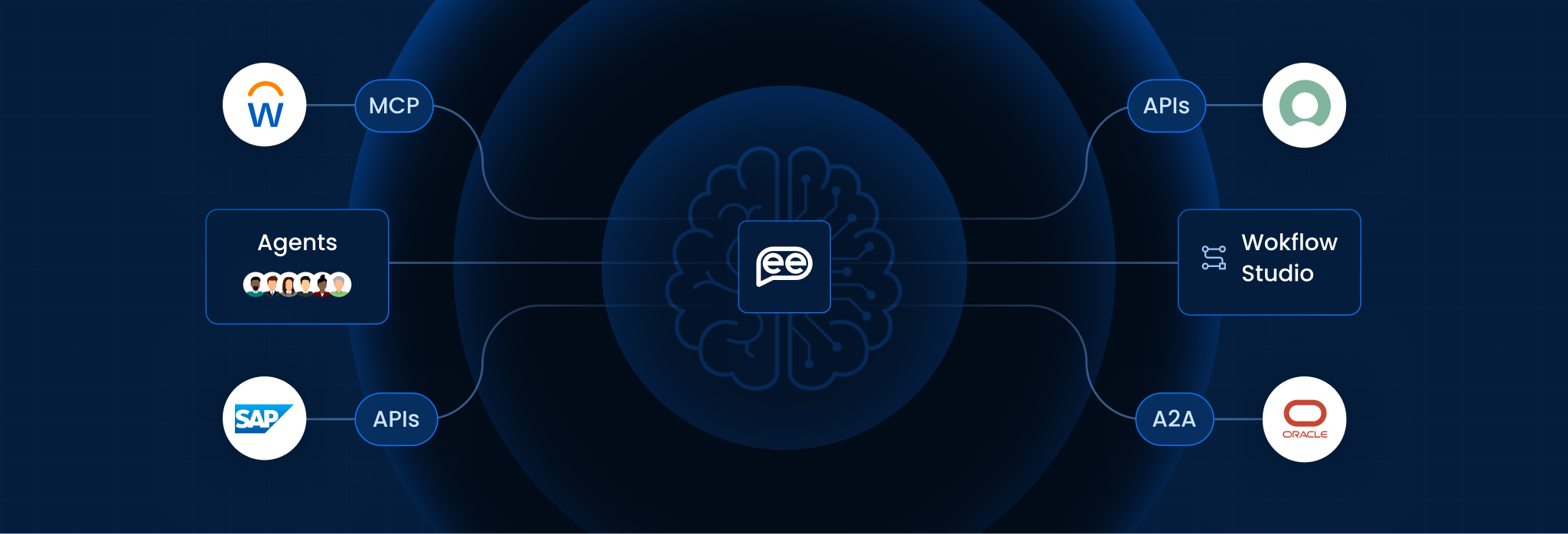
- Tool Use: It can securely access and manipulate external systems via [API Mesh] (e.g., updating a CRM, sending a Slack message, or querying a database).
- Memory & Context: It retains information across long workflows, remembering what it did in “Step 1” to inform its decision in “Step 5.”
- Self-Correction: If an action fails (e.g., a website is down), it can analyze the error and try an alternative method rather than just crashing.
Agentic AI vs. Generative AI
The confusion often lies between “Creating” vs. “Doing.”
| Feature | Generative AI (The Creator) | Agentic AI (The Doer) |
| Primary Goal | Generate text, code, or images. | Execute workflows and solve problems. |
| Interaction | Passive: Waits for a user prompt to act. | Proactive: Can trigger itself based on events. |
| Output | Information (an answer). | Action (a completed task). |
| Tools | Limited (mostly text-based). | Extensive (APIs, browsers, software). |
How It Works (The Cognitive Loop)
Agentic AI operates in a continuous four-step loop, often referred to as the “OODA Loop” (Observe, Orient, Decide, Act) of AI:
- Perception (Trigger): The agent detects a signal this could be a user command, a specific time of day, or an alert from a monitoring system (e.g., “Server CPU is at 99%”).
- Reasoning (The Plan): It uses a Large Language Model (LLM) to understand what needs to be done. It consults its [Knowledge Base] and formulates a step-by-step plan.
- Action (Execution): The agent uses specific “tools” (software integrations) to execute the first step of the plan.
- Reflection (Observation): It observes the result of that action. Did it work? If yes, it proceeds to Step 2. If no, it creates a new plan to overcome the obstacle.
Benefits for Enterprise
According to Gartner, by 2026, more than 20% of enterprise applications will use agentic AI to automate workflows, up from less than 5% in 2024.
- End-to-End Automation: Moves beyond simple “task” automation (RPA) to handle dynamic, judgment-based processes like [IT Service Management].
- Reduced Operational Latency: Agents don’t sleep. They process invoices, reset passwords, and route tickets 24/7, drastically reducing “Wait Time.”
- Scalability: Enterprises can scale support functions without linear headcount growth, as agents can handle thousands of concurrent threads.
Frequently Asked Questions
Is Agentic AI secure for enterprise data?
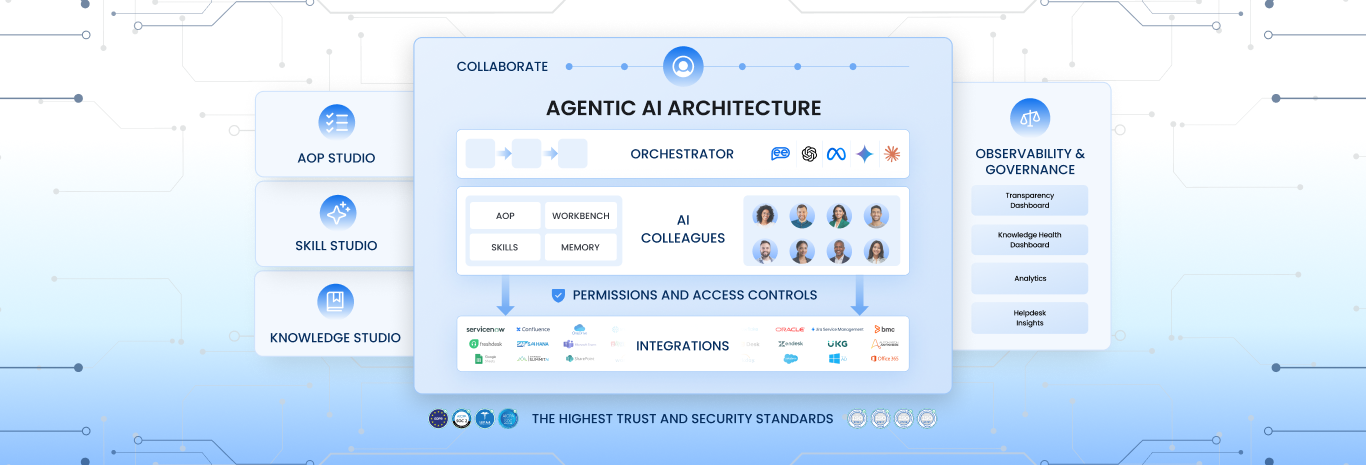
Yes, but it requires strict governance. Enterprise-grade agents use Role-Based Access Control (RBAC) to ensure they only access data the user is authorized to see. They also run in isolated environments to prevent data leakage
Does Agentic AI replace human jobs?
It typically replaces tasks, not roles. It automates high-volume, repetitive administrative work (Tier-1 support, data entry), allowing human employees to focus on strategic, creative, and interpersonal work.
How is this different from Robotic Process Automation (RPA)?
RPA is rigid; if a button moves on the screen, the bot breaks. Agentic AI is resilient; it uses reasoning to understand intent. If a process changes slightly, the agent adapts and finds a way to complete the task.
Can Agentic AI hallucinate?
Like all LLM-based systems, there is a risk. However, Agentic AI reduces this by using “Grounding” techniques—verifying facts against your internal company documents before taking action
How difficult is it to integrate?
Modern Agentic platforms are designed with “Low-Code” builders. They come with pre-built connectors for major systems (Salesforce, ServiceNow, Workday), allowing for rapid deployment in weeks rather than months.
What happens if an agent makes a mistake?
Agents utilize “Human-in-the-Loop” protocols. If an agent has low confidence in a decision or encounters a high-risk action (like transferring funds), it pauses and requests human approval before proceeding.
Want To Know More?
Book a Demo