

The “Portal Fatigue” Paradox
It is a common December scenario for a technology leader. You have just overseen a massive, multi-million dollar migration to a top-tier Human Capital Management (HCM) cloud platform. The data is clean, the dashboard is sleek, and the backend infrastructure is state-of-the-art.
Yet, when you look at the ticket volume for the HR helpdesk, the numbers have not budged. In fact, they might have increased.
Despite having the best systems in the world, your employees are still bypassing the “self-service” portal to email their HR representative directly. They find the portal navigation clunky, the search function generic, and the forms confusing. The result is that your highly paid HR Business Partners are still spending a third of their day acting as “human routers,” manually answering questions that the expensive new system was supposed to handle.
This is the “Portal Fatigue” paradox. The backend technology is modern, but the frontend service delivery feels stuck in 2015. The solution for the coming year is not another portal redesign; it is a fundamental rethinking of AI in HR.
The Strategic Shift for AI in HR in 2026
As we look toward 2026, the conversation surrounding AI in HR is maturing rapidly. For the past few years, the focus was on digitization getting paper files into the cloud. Now, the focus is on “Agency.”
Technology leaders are realizing that simply giving an employee access to a database isn’t enough. They need a layer of intelligence that can navigate that database for them. This is where AI in HR moves from being a “nice-to-have” novelty to a critical layer of enterprise infrastructure.
The goal is no longer just to organize data; it is to activate it. True AI in HR doesn’t just store the answer to “What is the maternity leave policy?”; it understands who is asking, checks their eligibility, and proactively offers to start the leave application workflow.
Moving Beyond Basic Chatbots in HR
To understand this shift, we must look at the limitations of legacy chatbots in HR.
In the early 2020s, many enterprises deployed first-generation bots. These were essentially search engines with a chat interface. If an employee typed “payroll,” the bot would paste a link to the payroll handbook. This was often frustrating for the user, who didn’t want to read a handbook they wanted to change their tax withholding.
In 2026, chatbots in HR are being replaced by “Transactional AI.” This new class of technology understands intent and can execute tasks across systems. It is the difference between a librarian who points to a shelf and an assistant who gets the book, opens it to the right page, and reads you the answer.
Why AI in HR is Now a CIO Priority
Historically, HR technology decisions were often made in silos, separate from the broader IT strategy. However, as AI in HR becomes more integrated into the daily workflow, it has firmly landed on the CIO’s desk.
Why? Because AI in HR is no longer just about “soft” metrics like employee sentiment. It is about “hard” operational efficiency and system integration.
When AI in HR is deployed correctly, it acts as the “connective tissue” between your disparate enterprise systems. Consider the onboarding process. Without AI, onboarding is a disjointed relay race between the Applicant Tracking System, the Identity Management System, and the Payroll System. It requires human intervention at every handoff.
With advanced AI in HR, an intelligent agent orchestrates this entire flow. It creates the email identity, provisions the laptop, sets up the direct deposit, and enrolls the new hire in benefits all without a human touching a keyboard. This level of automation turns AI in HR into a massive driver of IT efficiency, reducing the “access request” ticket volume that typically clogs the IT service desk.
The Intersection of AI and HR Systems
The success of ai and hr initiatives relies heavily on integration. A standalone AI tool is useless if it cannot read and write to the core system of record.
For the technology head, the evaluation criteria for AI in HR must center on API maturity. Can the AI read the vacation balance from the ERP in real-time? Can it write a new address update back to the HCM securely? The power of AI in HR is derived almost entirely from its ability to interact deeply with the existing tech stack.
Evaluating True Capabilities of AI in HR
With the market flooded with vendors claiming to have the best solution, distinguishing hype from reality is difficult. To effectively evaluate AI in HR platforms, technology leaders need to look for “Resolution Rate” rather than “Deflection Rate.”
Deflection simply means the employee didn’t talk to a human it doesn’t mean they were happy. Resolution means the problem is gone.
True AI in HR solves problems end-to-end. If an employee asks, “How do I add my spouse to my insurance?”, a basic system sends a PDF. A sophisticated AI in HR system says, “I can help with that. What is your spouse’s name and date of birth?” and then executes the update in the benefits portal.
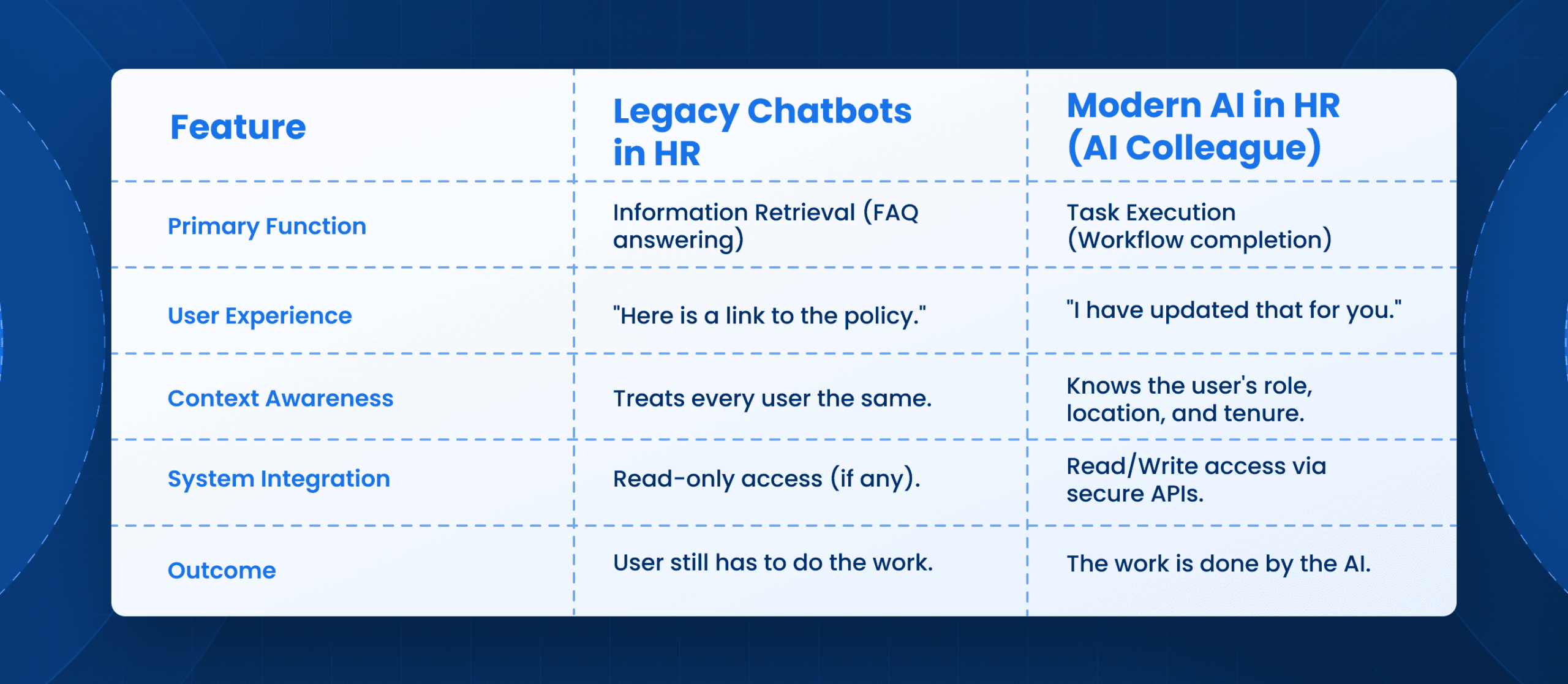
Comparing Traditional Chatbots in HR vs. AI Colleagues
The following table highlights the operational differences between the legacy approach and the modern 2026 standard for AI in HR.
Leena AI: Redefining AI in HR with AI Colleagues
At Leena AI, we view the progression of AI in HR not just as better software, but as the creation of a digital workforce. We define our solution as an “AI Colleague” an intelligent entity designed to work alongside your human teams to resolve requests instantly.
Our approach to AI in HR is built on the belief that employees deserve the same level of service they get as consumers. An AI Colleague does not sleep, does not get tired, and creates a unified interface for every employee need.
- For the Employee: The AI Colleague serves as a single point of contact. Whether they need to download a pay stub, request time off, or understand a complex visa policy, the AI handles it instantly within Microsoft Teams or Slack.
- For the Enterprise: Leena AI integrates deeply with back-end systems like Workday, SAP SuccessFactors, and Oracle. This allows our AI in HR solution to autonomously resolve thousands of tickets that would otherwise sit in a queue.
By handling the repetitive, transactional workload, Leena AI allows your human HR professionals to step away from the keyboard and focus on the strategic, people-centric work that actually drives culture and retention.
Governance and Security for AI in HR
As a technology leader, your enthusiasm for AI in HR is likely tempered by concerns about data privacy and governance. This is appropriate. HR data is some of the most sensitive information an enterprise possesses.
Implementing AI in HR requires a “Privacy by Design” architecture. In 2026, leading organizations are demanding that their AI partners adhere to strict data isolation protocols. The AI model should be able to learn from enterprise knowledge without commingling data with other customers.
Furthermore, AI in HR must support robust role-based access control (RBAC). The AI must know that a manager is allowed to see salary bands, but an individual contributor is not. This permission layer is critical to ensuring that AI in HR remains a tool for empowerment rather than a liability.
The Future of Chatbots in HR and Data Privacy
When discussing chatbots in hr and security, the concept of “auditability” is paramount. Every decision made or action taken by the AI must be logged. If an AI in HR system approves a leave request, there must be a digital paper trail verifying why that decision was made and which policy was applied.
This level of transparency turns AI in HR from a “black box” into a trusted, verifiable component of your corporate governance strategy.
Conclusion: The Operational Imperative
The adoption of AI in HR is no longer a speculative experiment. For large U.S. enterprises facing the dual pressures of cost management and high employee expectations, it is an operational imperative.
The leaders who succeed in 2026 will be those who look past the surface-level appeal of chatbots in hr and invest in deep, integrative AI in HR platforms. They will stop building portals that no one uses and start building intelligent workflows that meet employees where they are.
By embracing this shift, CIOs and CTOs can transform the HR function from a ticket-heavy cost center into a streamlined, automated engine of employee experience. The technology is ready; the question is whether your strategy is ready to harness the full potential of AI in HR.
Frequently Asked Questions
How does AI in HR differ from traditional HR automation tools?
Traditional automation usually follows a rigid script (e.g., “If form A is submitted, send email B”). AI in HR uses natural language understanding and reasoning to handle ambiguity. It can understand a user’s intent even if phrased uniquely and can navigate complex, multi-step workflows that would break a traditional script.
Is implementing AI in HR safe for sensitive employee data?
Yes, provided the solution is enterprise-grade. Secure AI in HR platforms use encryption, data isolation, and strict role-based access controls. They ensure that the AI respects the same permission levels as a human employee, preventing unauthorized access to sensitive data like compensation or health records.
Will AI in HR replace human HR business partners?
No. AI in HR is designed to replace tasks, not jobs. It handles the repetitive, transactional inquiries (Tier 0 and Tier 1 support) that currently consume 40-50% of an HR professional’s time. This frees up human HR teams to focus on complex, emotional, and strategic issues that require human empathy and judgment.
Why is agentic rag considered safer than pure generative AI?
Pure generative models rely on training data that can be outdated or hallucinatory. Agentic rag grounds every response in retrieved context (your docs) and verifies it with tool usage (your APIs). This “grounding” significantly reduces the risk of the AI making things up, as it is constantly checking its facts against real-time enterprise data.
How long does it take to deploy an AI in HR solution?
Unlike a massive ERP migration, deploying AI in HR is relatively fast. Since modern solutions sit on top of existing systems (like Workday or ADP), a functional AI Colleague can often be deployed in weeks. The focus is on integration and knowledge ingestion rather than infrastructure replacement.
What is the role of the CIO in driving ai and hr strategy?
The CIO acts as the architect of integration. While HR owns the policy, the CIO ensures that the AI in HR platform is secure, scalable, and properly connected to the broader IT ecosystem. The CIO ensures that ai and hr tools do not become “shadow IT” but are part of a unified enterprise technology strategy.