

Introduction
Agentic AI is no longer a futuristic concept—it is a practical reality reshaping how enterprises operate today. As a technology leader, you know the landscape is always shifting, and this evolution in artificial intelligence is truly turning heads. For CIOs and CTOs in large U.S. organizations, Agent-based AI isn’t just another buzzword; it represents a tangible way to enhance employee productivity and transform IT, HR, and Finance operations. I’ve witnessed AI agents move from a future vision to a real-world solution, and this blog explores what that shift means for enterprise leaders.
Understanding “Agentic”: What Does Agentic Mean in AI?
Before we dive into “Agentic AI,” let’s clarify the term “agentic.” In the context of Artificial Intelligence, “agentic” describes an AI system’s capacity for agency. This means the AI can perceive its environment, make decisions, and take autonomous actions to achieve specific goals. It’s about moving from passive tools that are limited to retrieving information (“search on steroids”, in essence) to active, intelligent partners that can also take action and transact for employees. This foundational “agentic” quality is what makes Autonomous AI agents so powerful.
What is Agentic AI? What is the definition of Agentic AI?
So, what is Agentic AI? The Autonomous AI agents definition centers on an AI that doesn’t just process information or answer questions, but actively completes tasks on behalf of users. An AI agent can be seen as a dedicated virtual assistant. But AI agents elevates this concept. It’s an intelligent system that synergizes knowledge with concrete actions. It does that by following defined company processes and fully adhering to the company’s employee access privileges.
Imagine an employee asks, “What’s my PTO balance?” A simple bot might provide the number. An Autonomous AI agents system, after stating “You have 7 days of Paid Time Off (PTO) remaining”, would then proactively engage: “Would you like me to request leave for you? For what dates?” and then execute that request. It would know to route the request to the employee’s manager for approval, as required by the company’s policies and workflows pertaining to PTO. This ability to understand, act, and interact across systems is the core of Autonomous AI agents. It’s more than just isolated AI agents; it’s a cohesive, comprehensive system where specialized agents are orchestrated to perform complex, multi-step tasks, distinguishing Agentic AI from simpler AI applications.
The Powerhouse: What are Autonomous AI agents Workflows?
The engine driving task completion in AI agents is the “agentic workflow.” So, what is an agentic workflow? It’s a structured, yet adaptable series of steps that an Autonomous AI agents follows to execute a task, mirroring your specific enterprise business processes. These Agent-based AI workflows are critical because they guide the AI to interact with various enterprise systems in the correct sequence.
For instance, onboarding a new employee traditionally involves multiple departments in a well-defined workflow. An Autonomous AI agents workflow can automate and coordinate this, from setting up IT access to enrolling in HR systems, ensuring a smooth experience, without deviating from company processes and policies. This capability to manage complex, cross-system use cases is a hallmark of effective Agentic AI workflows and directly addresses a major challenge: systems that don’t communicate with each other, resulting in a poor employee experience.
Blueprints for Intelligence: Agentic AI Frameworks and Architectures
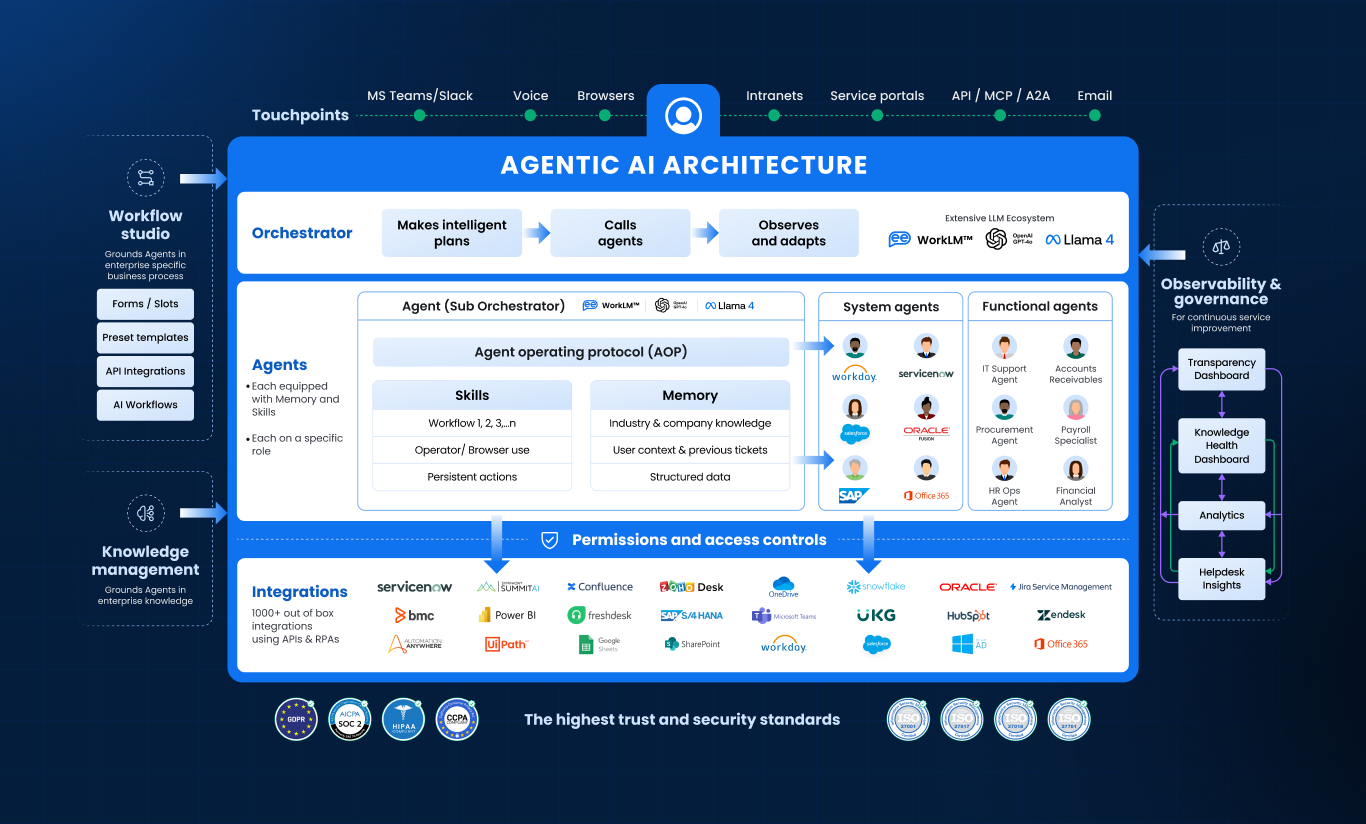
To deploy robust AI agents effectively, a comprehensive Agent-based AI framework or architecture is an essential foundation. This framework is the organizational backbone that enables Action-oriented AI to function reliably, securely, and at scale within an enterprise. Based on extensive experience, a well-structured Action-oriented AI framework includes:
- Touchpoints: These are the interfaces where employees interact with the Agent-based AI, such as enterprise chat applications (like Slack, Teams), voice, web browsers, intranets, text messages, WhatsApp, and mobile apps. The goal is ubiquitous accessibility.
- Orchestrator: The central intelligence of the Agentic AI framework. It interprets user requests, formulates plans, and delegates tasks to the appropriate specialized agents. It utilizes a broad ecosystem of Large Language Models (e.g., GPT-4, Llama 3, Mistral) and adapts as tasks progress.
- Agents: These are AI specialists, like an “IT Support Agent” or “Accounts Payable Analyst,” each equipped with specific AOP (“agent operating procedures”), skills, and memory to perform their designated functions within the Agent-based AI system.
- Workflow Studio: This component allows the Agentic AI to be grounded in your unique business processes by enabling the creation of custom AI workflows using forms, templates, and API integrations.
- Knowledge Management: This ensures the Agentic AI uses your enterprise-specific information, providing accurate and contextually relevant responses, crucially helping the AI to not “hallucinate” or invent information.
- Integrations: Seamless connection to your existing enterprise systems (HR, IT, Finance, etc.) is vital. A mature Agent-based AI framework offers numerous pre-built integrations.
- Permissions and Access Controls: The Agent-based AI must strictly adhere to all internal security protocols, access rules, and company policies.
- Responsible AI & Security: This encompasses transparency dashboards, analytics for ongoing improvement, and adherence to top-tier security and privacy standards (e.g., GDPR, SOC 2, HIPAA).
Such a holistic Agentic AI framework provides the flexibility needed to adapt to the rapidly changing AI landscape, allowing enterprises to swap underlying models and “future-proof” their investment.
Achieving Success: Leveraging Autonomous AI agents in Your Enterprise
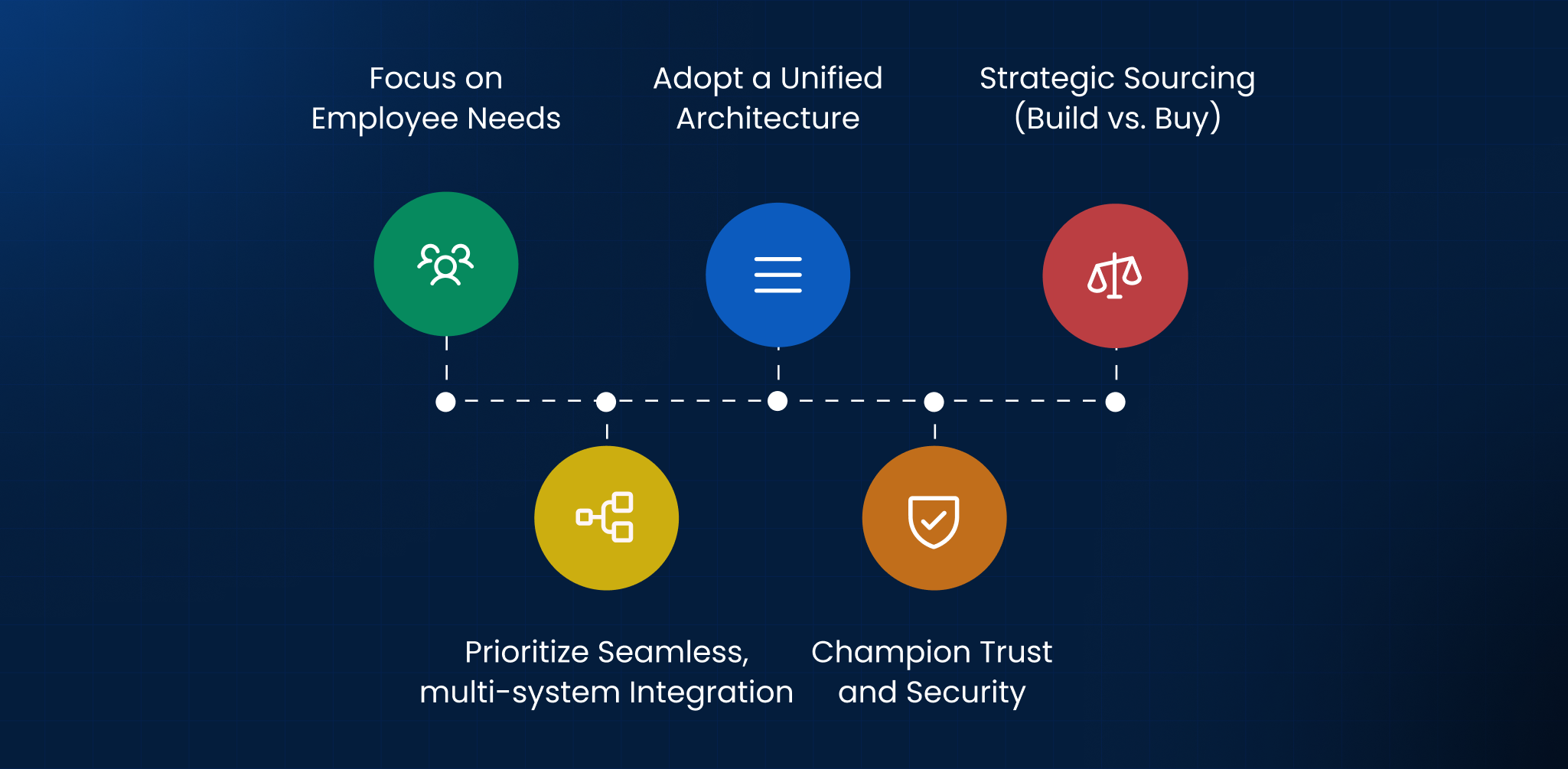
Successfully implementing Agent-based AI goes beyond technology deployment:
- Focus on Employee Needs: Begin by identifying key areas where Agent-based AI can alleviate employee frustrations, especially where multiple applications confuse.
- Prioritize Seamless, multi-system Integration: The true strength of Agentic AI lies in its capacity to unite disconnected systems.
- Adopt a Unified Architecture: Resist creating more AI silos. A central, orchestrating Autonomous AI agents platform is key to a consistent and efficient employee experience, unlike the confusion caused when every app has its own AI assistant.
- Champion Trust and Security: Ensure your Agentic AI solution adheres to rigorous security and data privacy standards, providing validated, trustworthy help.
- Strategic Sourcing (Build vs. Buy): Developing a comprehensive Autonomous AI agents framework from scratch is a massive undertaking, with high failure rates (less than 5% of such projects succeed after an average of 18 months of effort by 95% of companies ). Partnering with an experienced Agentic AI provider can accelerate success.
Agentic AI in Action: A few examples of Real-World Enterprise Use Cases
The applications of Agentic AI are transforming workplaces:
- IT Support Automation: An employee with an Outlook issue can have the Enterprise AI agents diagnose the problem (e.g., storage full), execute a solution (increase storage), and confirm resolution, all via chat. This can be extended to voice interactions or even guided screen-sharing sessions.
- HR Process Efficiency: Agentic AI can instantly answer queries like “Why is my paycheck lower this month?” and then proceed with the action to correct attendance records, and get manager approval for the correction, as defined by company policy. t. This significantly frees up HR personnel for more strategic initiatives, and it improves employee experience and employee satisfaction all at the same time
Navigating the Journey: Pitfalls to Avoid with Agentic AI
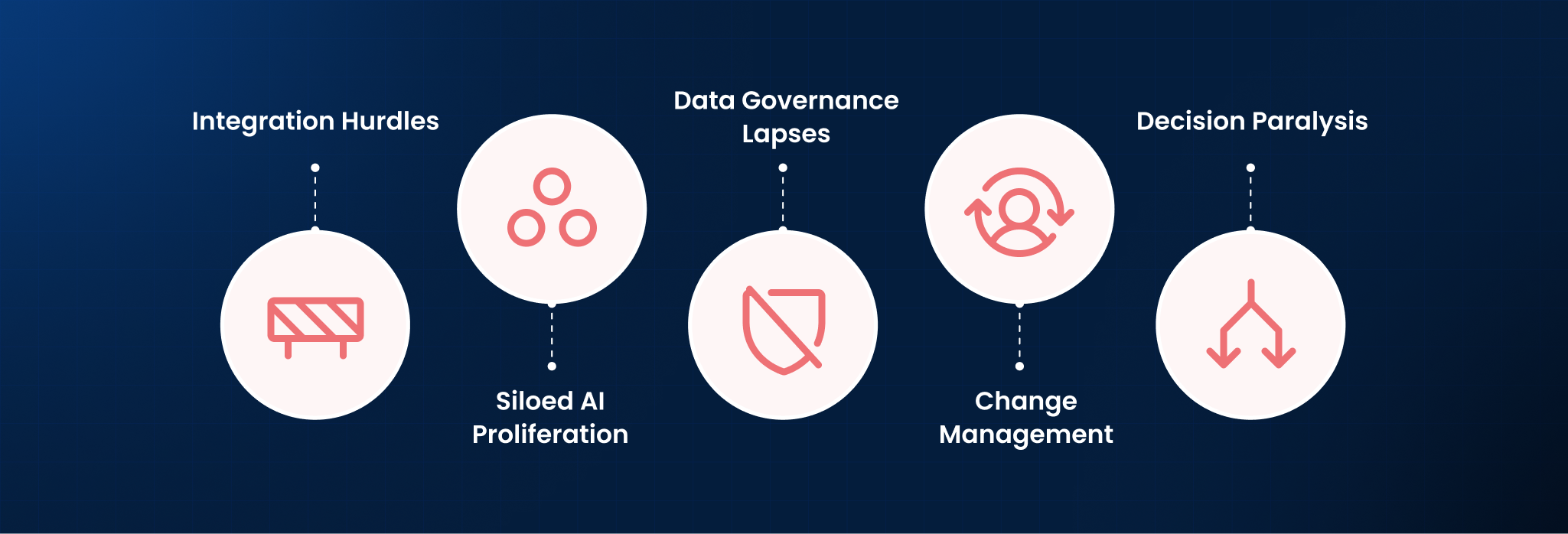
While powerful, the adoption of AI agents requires awareness of potential challenges:
- Integration Hurdles: The complexity of integrating with legacy enterprise systems can be underestimated.
- Siloed AI Proliferation: The temptation for each department or application to deploy its own AI assistant can undermine the goal of a unified Agent-based AI strategy, as these disparate AIs often don’t communicate.
- Data Governance Lapses: Failing to ensure the AI agents strictly adheres to data access and security policies can create significant risks.
- Change Management: Employees require support and training to adapt to working alongside Agentic AI.
- Decision Paralysis: The fast evolution of Large Language Models can cause hesitation. A flexible Agent-based AI framework mitigates this.
How Leena AI stands out in the Agentic AI crowd
Leena AI’s Agentic AI Architecture is designed to provide an end-to-end solution for enterprise-grade AI services. By combining a central Orchestrator, specialized Agents, the Workflow Studio, Knowledge Base, and out-of-the-box integrations, organizations can automate complex processes across different domains while maintaining strict security, compliance, and ethical standards. The incorporation of a Responsible AI framework ensures transparency, accountability, and continuous improvement—key factors for successful AI adoption in modern enterprises. Learn More here!
The Future is Agentic: What’s Next for Enterprise Agentic AI?
The trajectory of Agentic AI is towards even more proactive, autonomous, and deeply integrated enterprise intelligence. We can anticipate Enterprise AI agents systems that not only solve problems reactively but also predict and prevent issues. The future involves an Enterprise AI agents that personalizes and optimizes the entire employee lifecycle within your organization. This technology is fundamental to building a more agile, responsive, and intelligent enterprise, driving efficiencies, employee productivity, and overall employee satisfaction. AI agents is here to simplify complexity, enhance productivity, and elevate the employee experience. By understanding the agentic definition, the specifics of what Agentic AI is, the role of AI agents workflows, and the importance of robust Agent-based AI frameworks, you should be well-equipped to lead your enterprise into this new era of efficiency.
If you’re ready to explore how Enterprise AI agents can be tailored to your enterprise’s unique challenges and unlock new levels of productivity, I’d be happy to connect. This is a transformative journey, and the right expertise can make all the difference.
Frequently Asked Questions (FAQs) about Agentic AI
1. What is the core “agentic definition” when we talk about AI?
In the context of AI, the “agentic definition” refers to an AI system’s capacity for agency. This means the AI can perceive its environment, make independent decisions, and take autonomous actions to achieve specific goals. It’s about AI moving beyond passive responses to become an active participant in processes.
2. Can you give a simple “AI agents definition”? What is AI agents in essence?
Essentially, Agentic AI is an advanced form of artificial intelligence that doesn’t just answer questions or provide information, but actively performs tasks and completes actions on behalf of users. The AI agents definition emphasizes its ability to combine knowledge with action to get things done across various enterprise systems.
3. How does Agentic AI differ from generative AI?
While both are advanced AI, Agent-based AI is primarily focused on action and task completion within enterprise systems, guided by specific workflows and goals. Generative AI, on the other hand, excels at creating new content (text, images, code). An Agent-based AI system might use generative AI capabilities as one of its tools, but its core purpose is to act as an intelligent agent that executes tasks.
4. “What is an agentic workflow” and how do “AI agents workflows” help businesses?
An agentic workflow is a defined sequence of steps, decisions, and actions that an Agentic AI system follows to complete a specific business process. These Agent-based AI workflows help businesses by automating complex, often multi-system tasks (like employee onboarding or IT support resolution), ensuring consistency, improving efficiency, and freeing up human employees for more strategic work.
5. What are “Agentic AI frameworks” and why are they important for deploying AI agents ?
Agentic AI frameworks refer to the comprehensive architecture and underlying structure that enables AI agents to operate effectively, reliably, and securely within an enterprise. This framework typically includes components like an orchestrator, specialized agents, a workflow studio, knowledge management systems, integration layers, and robust security and permission controls. They are important because they provide the necessary foundation for scalable, manageable, and “future-proof” AI agents solutions.
6. What are the key benefits of implementing AI agents in an enterprise?
Implementing Agent-based AI offers several key benefits, including: * Enhanced employee experience by providing a single, intelligent point of contact for tasks and information, reducing confusion from too many apps. * Increased productivity by automating routine tasks and handling complex cross-system use cases. * Improved operational efficiency by streamlining processes across various departments like HR, IT, and Finance. * Reliable and trusted assistance, as enterprise-grade Agentic AI is designed to avoid hallucinations and follow strict data permissions.
7. How do “agentic AI workflows” specifically improve the employee experience?
Agentic AI workflows improve the employee experience by making interactions with company systems seamless and intuitive. Instead of employees needing to know which system to use for a specific task (e.g., requesting leave, resolving an IT issue), the Agent-based AI, guided by its workflows, handles these processes behind the scenes. This means employees get their tasks done quickly and easily, reducing frustration and allowing them to focus on their core responsibilities.
Learn more about Leena AI’s pioneering Agentic AI Architecture
Read Enterprise Customer Success Stories .
Check out why Gartner and many others recognise Leena AI as a leader in Agentic AI
Learn more about Voice-Enabled AI Colleague .
Sign up for our Webinars and Events