
Most enterprises don’t have an AI agent problem. They have a coordination problem.
The average enterprise stack now includes multiple AI agents – Microsoft Copilot for productivity, SAP Joule for ERP, maybe ServiceNow Now Assist for ITSM, and purpose-built agents for HR, Finance, and IT. Each one is capable on its own. None of them were designed to work together.
So what happens when an employee asks Copilot a benefits question? Copilot doesn’t know. That lives in the HR system. The employee switches tools, re-explains the problem, waits. Multiply that across every cross-system workflow in the enterprise, and you see the real cost: not just inefficiency, but a hard ceiling on what AI can actually deliver.
A2A removes that ceiling.
What A2A is – and what it isn’t
Agent-to-Agent (A2A) is an open protocol that gives AI agents a shared language for collaboration. It defines how agents discover each other, exchange context, hand off tasks, and confirm outcomes. No custom middleware. No point-to-point integrations.
Leena AI now supports A2A natively. That means your AI Colleagues – for IT, HR, and Finance – can coordinate with any A2A-compatible agent in your ecosystem. Copilot calls Leena. Leena calls Joule. Work moves across vendor boundaries as a single workflow.
What A2A is not: a theoretical roadmap item. It’s shipping. And it’s built on infrastructure that’s been live for months.
The foundation: MCP has been shipping since May
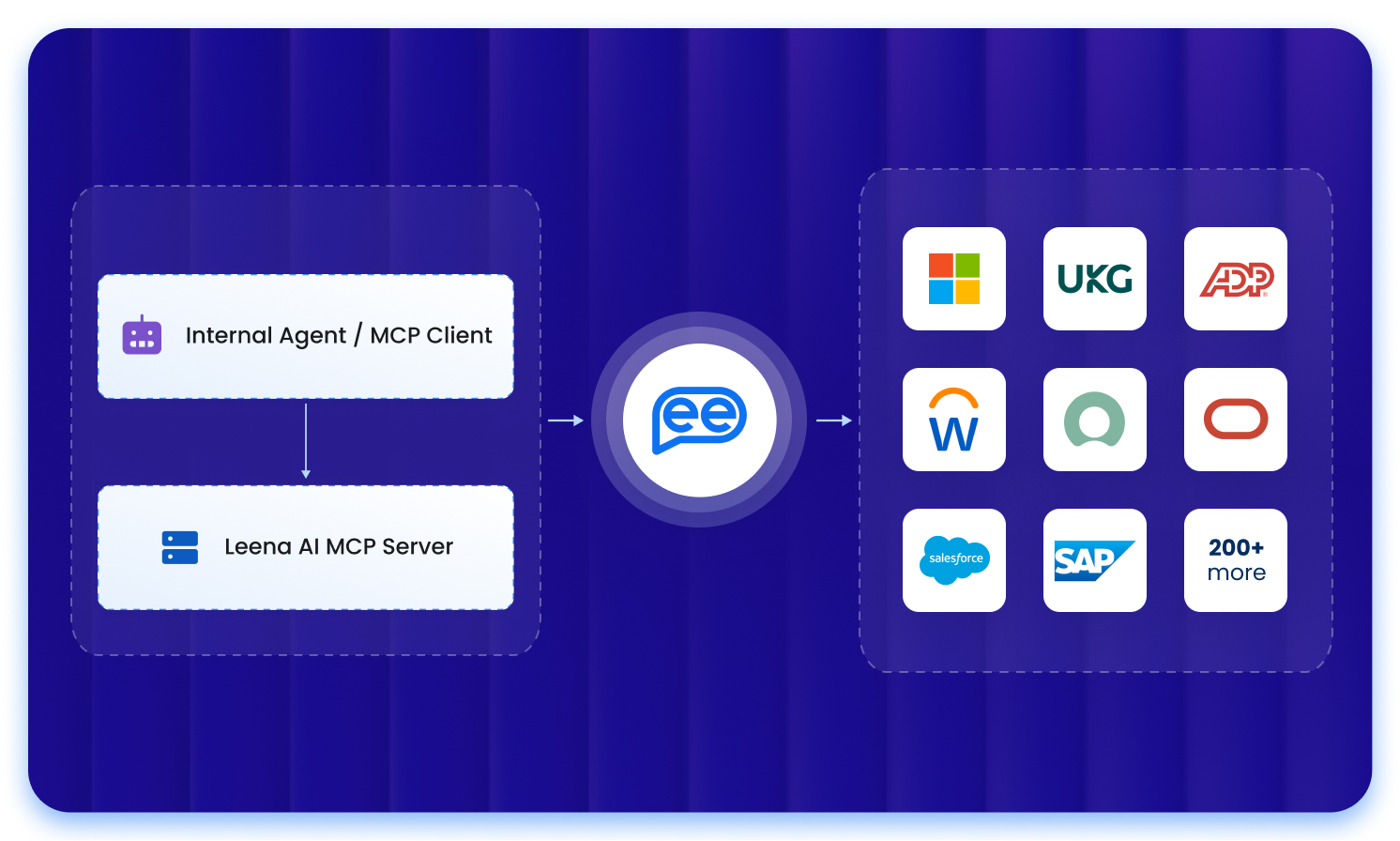
A2A didn’t appear out of nowhere. It sits on top of the Leena MCP Server, which has been live and in production since May 2026.
Here’s what MCP does: it turns your AI Colleague into a sub-agent that any MCP-compatible client can call. But the way it does this matters. Instead of exposing dozens of individual tools, forms, and workflows to the connecting application, Leena exposes one conversational surface. Your third-party app sends a natural-language instruction. The AI Colleague decides – on its own – which tools, knowledge sources, approval workflows, or custom processes to run, and returns the result.
This is the same orchestration brain that powers Leena on the web, Slack, and Teams. Same permissions. Same guardrails. Same grounded answers with authenticated source links. Just reachable programmatically.
The entire MCP integration surface is three tools: send_message, request_details, and cancel. That’s it. Tools, workflows, and processes can be added, renamed, or retired on the Leena side and your connected app keeps working. No re-integration. No broken schemas.
MCP is the connection layer. A2A is the coordination layer. Together, they give enterprises something that didn’t exist before: a multi-agent architecture where agents from different vendors actively work together, under one governance framework.
For teams ready to start building, the technical documentation walks through everything – from enabling the MCP Server and generating 0Auth credentials to connecting your first agent in Copilot Studio or watsonx Orchestrate. Setup guides for Microsoft Copilot Studio and IBM watsonx Orchestrate are live now.
Three things that change immediately
1. Cross-vendor workflows stop being projects
Before A2A, connecting two AI agents from different vendors meant integration work. APIs, middleware, data mapping, testing, maintenance. Every new connection was a project with a timeline.
A2A replaces that with a protocol. Agents communicate directly using structured envelopes with role-based permissions and built-in conflict resolution. The cost of connecting Agent A to Agent B drops from “a project” to “a configuration.”
2. Your existing investments start compounding
Most enterprises have already spent on Copilot, Joule, or both. Until now, those investments were locked inside their respective ecosystems.
A2A unlocks them. Copilot can invoke Leena’s enterprise AI Colleagues for IT, HR, and Finance. Joule can complete a task in SAP and hand the result back to Leena to finish the workflow in Workday. The agents you’ve already bought now operate as one system, not three separate purchases.
3. Governance stays centralized – even as agents decentralize
Here’s the risk most people don’t talk about with multi-agent setups: governance fragmentation. Each agent has its own permissions, its own audit trail, its own security model. Scale that across vendors and you’re managing compliance in five places instead of one.
Leena’s implementation solves this architecturally. Every interaction – whether it’s a direct chat, an MCP call, or an A2A coordination – runs through the same orchestration engine with the same per-user 0Auth 2.0 authentication, the same guardrails (PII detection, moderation, jailbreak detection), and the same audit logging. The agent resolves every request to a specific user’s identity and permissions. No anonymous access. No service-account firehose into your data.
Agents collaborate freely. Compliance stays in one place.
What the CEO thinks this means
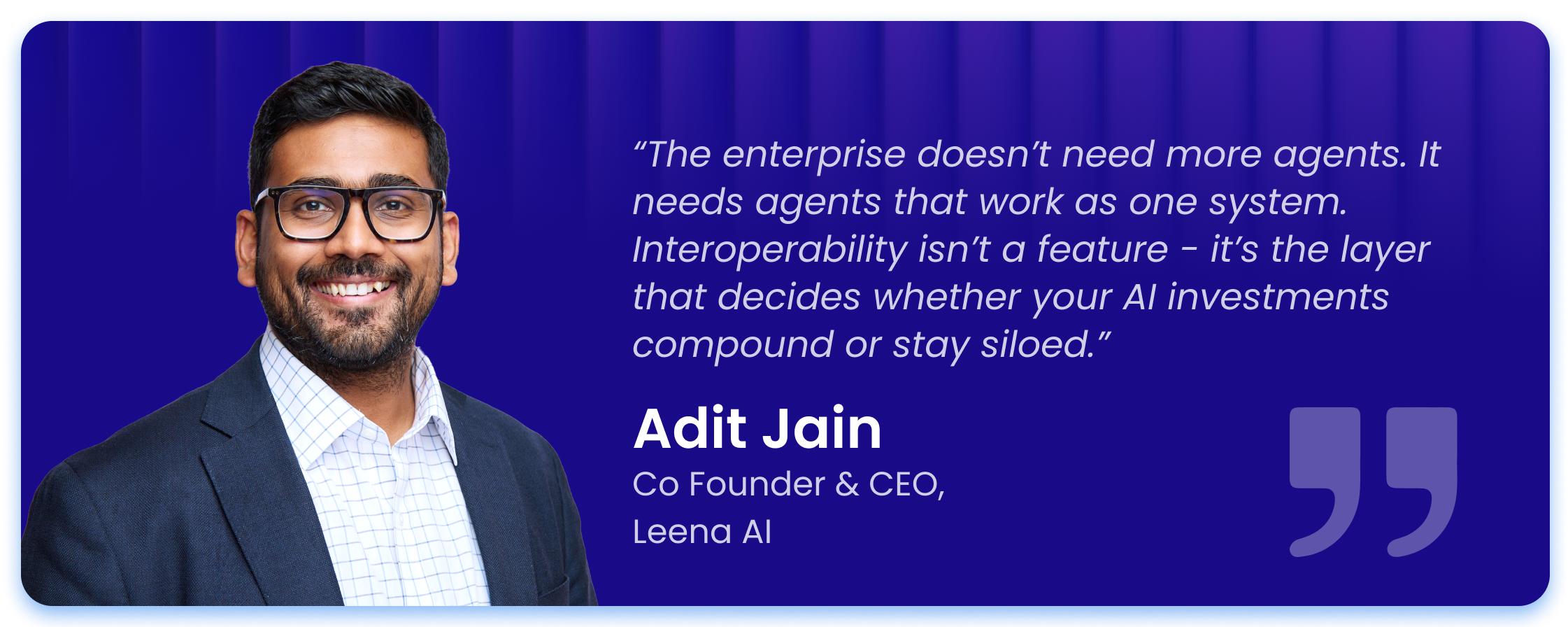
We agree. And we’d go further: the vendors who don’t open up their agents to protocols like A2A and MCP will find themselves on the wrong side of a purchasing decision. CIOs aren’t evaluating agents in isolation anymore. They’re asking which ones play well with the rest of their stack.
What this means for the CIO
The question isn’t “should we use AI agents?” That’s settled. The question is: how do you make the agents you already own work together without building a second integration layer on top of them?
A2A is the answer. It turns the multi-vendor agent landscape from a coordination headache into a composable system. Best-of-breed agents from different vendors, working together, governed centrally, deployed incrementally.
The walled-garden era of enterprise AI is ending. The agents that win will be the ones that work with others.
See A2A in action. Request a demo →
Go deeper. Watch The CIO’s Guide to Agent-to-Agent Interoperability & MCP — a strategy session for technology leaders navigating the multi-agent landscape.
Ready to integrate? Explore the technical documentation →